
featered

Way2net » featered

Informe 2026: Marketing Digital en las PyMEs Argentinas

¿Cuánto invierten las PyMEs argentinas en marketing digital?

Cuánto invierten las PyMEs argentinas en marketing digital, qué canales utilizan, qué resultados obtienen y cómo están incorporando inteligencia artificial.

Por Cesar Fernandez | Director, Way2net Agencia de Marketing Digital | Agosto 2026

Los principales datos del marketing digital en las PyMEs argentinas en 2026

IndicadorResultado
Empresas encuestadas187
Inversión promedio mensualUSD 1.847
Inversión medianaUSD 780
Utilizan Meta Ads73%
Utilizan Google Ads61%
Utilizan SEO44%
No miden claramente el ROI46%
Utilizan IA generativa64%
Planea aumentar inversión en SEO42%
Planea aumentar inversión en GEO22%

Cuando le preguntás a una PyME cuánto gasta en marketing digital, lo primero que obtenés es silencio. Después viene un número que casi siempre subestima la realidad, porque nadie suma la plataforma de email, la herramienta de diseño, las horas del community manager y la campaña de Meta que tiene corriendo desde hace tres meses sin haberla revisado.

Esa desconexión entre lo que las empresas creen que invierten y lo que en realidad gastan fue el punto de partida de este estudio. En Way2net llevamos más de 15 años trabajando con PyMEs argentinas, y una de las conversaciones más recurrentes en las primeras reuniones con nuevos clientes es exactamente esa: “no sé bien cuánto estoy gastando en marketing y tampoco sé si está funcionando”.

Entre febrero y julio de 2026 encuestamos a 187 empresas PyME de distintos sectores y tamaños para entender cuánto invierten realmente en marketing digital, en qué canales concentran ese presupuesto, qué resultados perciben y cuáles son los principales obstáculos. Los resultados confirman algunas intuiciones y desmienten otras.

¿Cuánto invierten las PyMEs argentinas en marketing digital?

7 conclusiones del estudio

  1. La inversión mediana de las PyMEs encuestadas es de USD 780 mensuales.
  2. Meta Ads es el canal de mayor adopción.
  3. Google Ads continúa siendo fundamental para capturar demanda.
  4. SEO tiene menor adopción pero mejor percepción de ROI a largo plazo.
  5. Casi la mitad de las empresas no mide correctamente el retorno.
  6. La IA generativa ya está incorporándose a los equipos de marketing.
  7. GEO comienza a aparecer como un nuevo territorio de inversión.

Metodología

El relevamiento se realizó mediante entrevistas semiestructuradas y un formulario online distribuido entre empresas de la base de clientes activos y ex-clientes de Way2net, más una red de contactos del sector empresarial. El universo resultante no es una muestra representativa del tejido PyME argentino en su totalidad: está sesgado hacia empresas que ya tienen algún nivel de presencia digital y que, en general, ya tomaron la decisión de invertir en el canal. Esto es importante tenerlo en cuenta al leer los números: las empresas que todavía no invirtieron nada en marketing digital no están representadas aquí.

El 63% de los participantes se ubica en el área metropolitana de Buenos Aires. El resto se distribuye entre Córdoba (11%), Rosario (8%) y otras provincias. En cuanto al tamaño, el 48% tiene entre 5 y 25 empleados, el 34% entre 26 y 100 y el 18% restante supera los 100 empleados —aunque este último grupo está en el límite de lo que habitualmente se considera PyME.

Los sectores más representados: servicios profesionales (22%), tecnología y software (18%), retail y comercio (16%), gastronomía y hospitalidad (13%), salud (11%) y educación (9%).

El número que todo el mundo quiere saber: ¿cuánto se invierte?

La inversión promedio mensual en marketing digital entre las PyMEs encuestadas es de USD 1.847. Pero ese número solo tiene sentido si se mira la distribución, porque la media está distorsionada por un grupo pequeño de empresas con presupuestos altos.

La mediana es USD 780. Eso es más representativo de lo que invierte la empresa “del medio” de la distribución.

La distribución completa muestra cuatro grupos bastante diferenciados:

  • Inversión mínima (menos de USD 800/mes): 19% de los encuestados. En general corresponde a empresas muy pequeñas o con presencia digital todavía incipiente. El gasto se concentra en una sola plataforma, casi siempre Meta.
  • Inversión básica (USD 800 a USD 2.000/mes): 31%. El segmento más poblado. Suelen tener activas campañas de Meta o Google Ads pero sin SEO, GEO ni estrategia de marketing integral.
  • Inversión media (USD 2.000 a USD 3.500/mes): 28%. Empieza a aparecer el trabajo multicanal y más integral: combinan pauta con SEO o con gestión de redes sociales.
  • Inversión alta (más de USD 3.500/mes): 22%. Empresas con equipos más grandes o sectores de alta competencia. Trabajan con agencia o tienen al menos un perfil interno de marketing.

Un dato que sorprende: el 10% invierte más de USD 5.000 por mes en marketing digital. No son empresas grandes en el sentido corporativo — son PyMEs en sectores muy competitivos como fintech, software B2B, materiales para construcción o turismo premium, donde el costo de adquisición de un cliente justifica esa inversión o en donde la inversión en digital se ha transformado en uno de sus principales canales de ingresos de nuevos clientes.

“Nosotros empezamos gastando USD 400 por mes en Meta y creíamos que era mucho. Cuando calculamos lo que valía un cliente nuevo nos dimos cuenta de que con 10 clientes nuevos al mes esa inversión se pagaba en la primera semana.”

— Responsable comercial, empresa de software SaaS, Buenos Aires

¿En qué canales se invierte?

El canal con mayor adopción es Meta Ads (Facebook e Instagram): el 73% de los encuestados lo usa. Le sigue Google Ads con 61%. El Posicionamiento SEO orgánico aparece en tercer lugar con 44%, y el email marketing —que era mucho más relevante hace cinco años— quedó en el cuarto lugar con 29%. Sigue siendo muy incipiente aun la adopción de estrategia basadas en GEO (trabajar el posicionamiento en IA)

La distribución del presupuesto dentro de las empresas que usan múltiples canales es:

  • Google Ads: 36% del presupuesto promedio
  • Meta Ads: 31%
  • SEO y contenidos: 19%
  • Diseño web y desarrollo: 8% (gasto más esporádico que mensual)
  • Email marketing y automatización: 6%

Lo llamativo no es qué canal lidera, sino la brecha entre el presupuesto y el retorno percibido. En las respuestas abiertas, el SEO aparece como el canal con mejor ROI a largo plazo en las empresas que lo trabajan consistentemente —pero es el tercero en adopción. La explicación más común: “requiere tiempo para ver resultados y no tenemos paciencia para eso”.

Google Ads genera resultados rápidos pero su costo de adquisición tiende a subir con el tiempo. Las empresas que llevan más de 18 meses con Ads activos sin SEO muestran en promedio un CPL (costo por lead) 40% más alto que las que combinan ambos canales.

El caso específico de Meta Ads

Meta sigue siendo el canal de entrada para la mayoría de las PyMEs argentinas por dos razones muy prácticas: la barrera de inicio es baja y el targeting por intereses permite llegar a una audiencia razonablemente relevante sin una infraestructura técnica compleja. Sin embargo, el 54% de quienes usan Meta admite no haber configurado correctamente el píxel de seguimiento ni tener datos de conversión confiables. Están invirtiendo —a veces varios miles de dólares al mes— sin saber si las ventas provienen de esa inversión o de otra fuente.

Este es uno de los problemas estructurales más frecuentes en PyMEs: la plataforma facilita tanto el inicio que omite la instrumentación básica. Y sin datos de conversión, la optimización es prácticamente ciega.

Diferencias por sector: no todos los rubros se parecen

Los sectores de tecnología y software y materiales para construcción lideran en inversión promedio (USD 2.340/mes) y en adopción de SEO (68%). Tiene sentido: son empresas que entienden el canal, cuyos clientes buscan activamente sus soluciones en Google, y donde el valor de un contrato justifica una inversión sostenida en posicionamiento orgánico.

El sector de servicios profesionales (estudios contables, jurídicos, consultoras) es el que muestra el crecimiento más fuerte interanual: +47% en presupuesto promedio respecto a 2025. La explicación es directa: post-pandemia, estos profesionales entendieron que la reputación online importa, y la competencia en Google se volvió real.

En el extremo opuesto, la gastronomía tiene el menor presupuesto promedio (USD 420/mes) y la mayor concentración en un solo canal (Meta). No es que la inversión sea ineficiente —en gastronomía, Instagram sigue siendo el canal con mayor influencia en la decisión de visita—, sino que el modelo de negocio no tiene margen para experimentar con múltiples canales.

Un hallazgo contraintuitivo: el sector de retail tiene la adopción más alta de Meta Ads (83%) pero también los índices más bajos de satisfacción con los resultados. La competencia en Meta para productos de consumo masivo es muy alta, los CPMs subieron significativamente en 2025-2026 y el algoritmo favorece cada vez más las cuentas con mayor volumen de datos de conversión —que generalmente son las empresas más grandes.

El problema del ROI: quién lo mide y quién no

El 46% de los encuestados admite no tener métricas claras de retorno sobre la inversión en marketing digital. No es que los resultados sean malos necesariamente —en muchos casos el negocio está funcionando—, sino que la atribución no está configurada para saber qué parte del crecimiento proviene del canal digital.

De quienes sí miden, los promedios de ROI declarados son:

  • Google Ads (SEM): 2.9x en el primer año
  • SEO orgánico: 1.6x en el primer año, 4.2x al tercer año
  • Meta Ads: 2.1x (con alta varianza — los extremos son muy amplios)

La diferencia del SEO entre año 1 y año 3 es la clave del argumento para trabajarlo desde temprano: el canal se paga poco el primer año y mucho más los siguientes, porque el contenido sigue generando tráfico sin inversión incremental.

Pero hay que ser honesto con el dato también: las empresas que miden el ROI correctamente son, en promedio, las que ya tienen cierto nivel de madurez digital. Los números pueden estar sesgados hacia arriba por selección: quienes miden son los que obtienen buenos resultados y por eso se toman el trabajo de medirlos.

La inflación y el dólar como distorsionadores permanentes

El 67% de los encuestados menciona la volatilidad cambiaria como el principal obstáculo para planificar la inversión en marketing digital. No es un problema menor: las plataformas cobran en dólares, pero muchos negocios generan ingresos en pesos. Cuando el tipo de cambio sube, el presupuesto en pesos que alcanzaba para USD 1.000 el mes anterior ya no cubre lo mismo.

Esto genera un comportamiento muy argentino: el 38% de las PyMEs encuestadas ajusta el presupuesto de marketing mes a mes según la situación cambiaria, en lugar de mantener una inversión sostenida. El problema es que los algoritmos de las plataformas publicitarias necesitan consistencia para optimizar. Una cuenta que sube y baja el presupuesto constantemente nunca completa la fase de aprendizaje y nunca llega a sus resultados potenciales.

Las empresas que mejor navegan esta restricción son las que dolarizaron su tarifa (facturan en USD o con precios indexados), como por ej. las inmobiliarias o las que trabajan principalmente con canales que no requieren inversión publicitaria constante, como el SEO orgánico.

“Nosotros decidimos mantener la inversión en Google Ads estable en dólares aunque eso a veces signifique ajustar otras cosas. La alternativa —subir y bajar el presupuesto todo el tiempo— es peor: perdemos el posicionamiento que construimos y después cuesta más recuperarlo.”

— Gerente de marketing, empresa de servicios financieros, CABA

Qué hacen diferente las PyMEs que mejor invierten

Del grupo que invierte más de USD 2.000 por mes y declara resultados satisfactorios, emergen algunos patrones consistentes que los diferencian del resto.

Miden desde el inicio. Antes de lanzar cualquier campaña tienen configurado el seguimiento de conversiones. No empiezan a anunciar y después tratan de entender qué funcionó. El píxel de Meta, el tag de Google Ads y Google Analytics 4 están correctamente vinculados desde el día uno.

Combinan canal pago con SEO. El 79% de este grupo trabaja simultáneamente con pauta y SEO, frente al 31% del resto de la muestra. No lo hacen por sofisticación teórica sino porque aprendieron por experiencia que cuando las campañas de Ads se cortan —por presupuesto, por cuentas suspendidas, por cualquier razón— el tráfico orgánico sigue llegando.

Trabajan con un proveedor estable. Solo el 12% de este grupo cambió de agencia o freelance en los últimos 12 meses, frente al 34% del grupo de menor inversión. La rotación constante de proveedores implica empezar de cero con el conocimiento del negocio cada vez. Y el marketing digital necesita aprendizaje acumulado para optimizarse.

Tienen un responsable interno del canal. No necesariamente un equipo de marketing, pero sí alguien dentro de la empresa que revisa los reportes, que tiene acceso a las cuentas y que es el interlocutor principal con la agencia. Las empresas donde “el marketing lo maneja todo la agencia sin que nadie internamente lo supervise” son las más vulnerables a inversión ineficiente.

Planifican con trimestres, no con meses. En lugar de decidir el presupuesto de marketing mes a mes según cómo va el negocio, estas empresas planifican por trimestres y mantienen la inversión aunque un mes sea flojo. Entienden que el marketing digital funciona como compuesto: los meses malos son parte del proceso, no una señal de que el canal no funciona.

¿Cuánto invierten las PyMEs argentinas en marketing digital en 2026?

Los errores más comunes en PyMEs que invierten pero no ven resultados

Más allá de la falta de medición, los errores más frecuentes que identificamos entre las empresas con peores resultados son:

Invertir en pauta sin tener el sitio web en condiciones. El 41% de las empresas que gastan más de USD 500 por mes en Google Ads tiene un sitio que no pasa los Core Web Vitals de Google —es decir, que carga lento en móvil, tiene problemas de interactividad o inestabilidad visual. Mandar tráfico pago a un sitio lento es como llenar un balde con agujeros.

No tener una landing page específica. El 57% de quienes hacen Ads manda el tráfico a la home del sitio en lugar de a una página optimizada para la conversión. La home está diseñada para dar contexto general, no para convertir una intención específica de búsqueda en una acción concreta.

Usar Meta para vender directamente cuando el producto necesita educación. Algunos productos y servicios requieren que el potencial cliente entienda por qué los necesita antes de considerar la compra. Meta funciona para capturar demanda existente o para generar awareness, pero no siempre es el canal adecuado para demanda latente que necesita ser educada. En esos casos, el SEO de contenidos y Google Ads en búsqueda suelen funcionar mejor.

No tener presupuesto para creatividades. Las campañas de Meta dependen críticamente de la calidad de las piezas gráficas y de video. El 48% de los encuestados admite usar creatividades genéricas o sin renovación durante más de tres meses. El algoritmo de Meta premia la novedad: las mismas piezas se “cansan” —la audiencia deja de responder— y el CPM sube.

Lo que viene: tendencias de inversión para el segundo semestre de 2026

El 61% de los encuestados planea mantener o aumentar su presupuesto de marketing digital en el segundo semestre de 2026. El 24% lo mantendrá igual. Solo el 15% planea reducirlo.

Los canales donde más se proyecta crecimiento: SEO (42% planea aumentar la inversión), video corto para redes (38%) y GEO —optimización para motores de inteligencia artificial como ChatGPT o Google AI Overviews— (22%). Este último número es significativo porque hace 12 meses casi ninguna PyME argentina sabía lo que era el GEO.

La inteligencia artificial está cambiando no solo cómo la gente busca, sino cómo las empresas generan contenido. El 64% de los encuestados ya usa alguna herramienta de IA generativa para producir contenido de marketing. El uso no siempre implica calidad: el contenido generado masivamente con IA sin revisión editorial está generando el efecto contrario al deseado en muchos casos, con penalizaciones de Google por contenido thin o genérico.

Conclusiones y recomendaciones

Los datos de este estudio apuntan a algunas conclusiones claras para las PyMEs argentinas que quieren invertir mejor en marketing digital.

La inversión mediana ronda los USD 780 por mes, pero ese número solo tiene sentido si viene acompañado de medición. Sin configurar el seguimiento de conversiones, cualquier inversión es un gasto con retorno desconocido.

El SEO sigue siendo el canal con mejor costo por resultado a largo plazo, pero requiere consistencia y tiempo. Las PyMEs que empezaron a trabajarlo hace dos o tres años están viendo resultados que las empresas que lo postergaron no pueden replicar rápidamente.

La inflación y el tipo de cambio son obstáculos reales, pero las empresas que mejor los manejan son las que planificaron la inversión en dólares desde el inicio y mantuvieron la consistencia aun cuando el entorno fue volátil.

Y el problema más extendido no es el presupuesto —es la falta de medición. Un presupuesto bajo bien medido y optimizado supera a un presupuesto grande gestionado sin datos.

Si querés evaluar cómo está tu empresa en relación a estos parámetros, podemos hacer un diagnóstico sin cargo.

Preguntas frecuentes sobre inversión en marketing digital para PyMEs

¿Cuánto debería invertir una PyME argentina en marketing digital?

No existe un presupuesto universal. En el estudio de Way2net sobre 187 PyMEs argentinas, la inversión mediana mensual en marketing digital fue de USD 780 y el promedio alcanzó USD 1.847. El presupuesto adecuado depende del rubro, la competencia, el ciclo de venta y los objetivos comerciales. Para campañas de publicidad o SEO, lo importante es contar con un presupuesto suficiente para sostener la estrategia y medir resultados.

¿Qué canal de marketing digital funciona mejor para PyMEs?

Depende del rubro, del ciclo de venta y de si el producto tiene demanda existente o hay que generarla. Si hay búsqueda activa en Google (la gente googlea lo que vendés), Google Ads y SEO pueden ser una combinación especialmente adecuada. Si el producto necesita mostrarse visualmente o si la audiencia no sabe que te necesita hasta que te ve, Meta Ads funciona mejor como canal de entrada. La respuesta honesta es que para la mayoría de los negocios la combinación de canales supera al canal único.

¿Cuánto tiempo tarda en verse el ROI del marketing digital?

Los tiempos varían según el punto de partida del sitio, la competencia y el tipo de búsqueda. Las campañas pagas pueden generar datos y conversiones en períodos más cortos, mientras que SEO suele requerir una inversión sostenida para consolidar resultados. En campañas de Google Ads o Meta Ads, los primeros resultados aparecen dentro del primer mes, aunque la optimización real lleva entre 60 y 90 días. Por eso la estrategia más inteligente suele combinar pauta (resultados rápidos) con SEO (resultados sostenibles): la pauta traccciona mientras el SEO madura.

¿Conviene contratar una agencia de marketing digital o manejar todo internamente?

Depende del volumen de trabajo, la complejidad de las campañas y las capacidades que la empresa necesita. Una agencia permite acceder a perfiles especializados sin contratar cada función individualmente, mientras que un equipo interno puede tener sentido cuando existe suficiente volumen, presupuesto y necesidad de coordinación diaria. Para la mayoría de las PyMEs, una agencia es más eficiente hasta que el volumen de trabajo justifica contratar un equipo interno completo.

¿Cómo sé si mi agencia de marketing digital está haciendo un buen trabajo?

Los KPIs básicos a revisar mensualmente: costo por lead (o costo por venta), tasa de conversión del tráfico, posiciones en Google para las keywords principales y el porcentaje de tráfico orgánico sobre el total. Si tu agencia no te reporta estas métricas de forma clara y contextualizada —no solo capturas de pantalla de Analytics—, es una señal de alerta. También es importante que tengas acceso directo a todas las cuentas: Google Ads, Meta Business, Search Console. Son tus cuentas, no de la agencia.

¿Cuánto invierten las PyMEs argentinas en marketing digital?

Según el estudio realizado por Way2net sobre 187 PyMEs argentinas en 2026, la inversión mensual mediana fue de USD 780 y el promedio alcanzó USD 1.847.

¿Qué canales de marketing digital utilizan más las PyMEs argentinas?

En la muestra relevada por Way2net, Meta Ads fue utilizado por el 73% de las empresas, Google Ads por el 61% y SEO por el 44%.

¿Cuántas PyMEs utilizan inteligencia artificial en marketing?

El 64% de las empresas relevadas declaró utilizar herramientas de inteligencia artificial generativa en actividades relacionadas con marketing.

Sobre el autor

Cesar Fernandez es fundador y director de Way2net, agencia de marketing digital con más de 15 años de operación en Argentina, Estados Unidos y América Latina. Ha gestionado más de USD 95 millones en inversión publicitaria digital y trabajó con empresas de sectores que van desde software y fintech hasta retail y salud. Escribe sobre estrategia digital, SEO y tendencias del mercado argentino.

Medical SEO: The Complete Guide to Growing Healthcare Visibility Online

medical seo strategy for healthcare websites

Introduction

Medical SEO has become an essential growth driver for healthcare providers in a digital-first environment where patients rely heavily on search engines to make decisions. Whether they are researching symptoms, comparing treatments, or looking for nearby specialists, the majority of healthcare journeys now begin online.

For clinics, hospitals, and private practices, this shift represents both a challenge and an opportunity. Without a strong medical SEO strategy, even highly qualified providers risk losing visibility to competitors who invest in digital presence. On the other hand, those who prioritize SEO can attract highly qualified traffic, build trust at scale, and convert online searches into real patient appointments.

Unlike other industries, healthcare requires a higher standard of content quality, accuracy, and authority. This makes medical SEO not just a marketing tactic, but a long-term investment in credibility and patient relationships.

What is Medical SEO?

Medical SEO is the process of optimizing healthcare-related websites to improve their visibility in search engines like Google. It combines technical optimization, content strategy, and authority building to ensure that medical providers appear in relevant search results.

This includes:

  • Optimizing service pages (e.g., cardiology, dermatology)
  • Creating educational content for patients
  • Improving website performance and usability
  • Enhancing local search presence

The ultimate goal is to connect healthcare providers with users who are actively searching for medical information or services.

Why Medical SEO is Critical for Healthcare Providers

The healthcare industry has undergone a massive digital transformation. Patients are no longer passive recipients of care—they are informed consumers who research extensively before choosing a provider.

  • Most patients search online before booking an appointment
  • Mobile searches dominate healthcare queries
  • “Near me” searches continue to grow rapidly

Business impact:

A strong medical SEO strategy delivers:

Long-term, compounding growth

Higher patient acquisition through organic channels

Reduced dependency on paid advertising

Stronger brand authority and trust

Key benefits of medical SEO:

  • Increased visibility: Reach patients actively searching for care
  • Qualified traffic: Attract users with real intent
  • Higher credibility: Build trust through authoritative content
  • Sustainable growth: Reduce reliance on paid advertising

Studies show that most users don’t go beyond the first page of search results, making SEO essential for discovery.

What Makes Healthcare SEO services Different?

Understanding Google’s YMYL and E-E-A-T in Medical SEO

Healthcare websites fall under Google’s Your Money or Your Life (YMYL) category. This means content is held to stricter quality standards because it can impact a user’s health or safety.

What this means for your SEO for healthcare strategy:

To rank well, your content must demonstrate E-E-A-T (Experience, Expertise, Authority, Trust):

  • Experience ? Real-world medical expertise
  • Expertise ? Qualified authors and professionals
  • Authority ? Recognition within the industry
  • Trustworthiness ? Accurate, transparent, and safe information

Practical implementation:

  • Include author bios with credentials
  • Cite reliable medical sources
  • Keep content updated and accurate
  • Add disclaimers where necessary

Search engines prioritize content reviewed or created by medical professionals, ensuring reliability and safety for users.

medical seo services

Core Components of a Successful SEO for Healthcare Strategy

1. Keyword Research with Patient Intent

Keyword research in healthcare requires a deep understanding of patient behavior.

Types of keywords:

  1. Informational searches
    • “What are symptoms of diabetes?”
  2. Navigational searches
    • “Best hospital in Buenos Aires”
  3. Transactional searches
    • “Book appointment with cardiologist”

Strategy tips:

  • Focus on long-tail keywords
  • Use natural, patient-friendly language
  • Target both symptoms and treatments
  • Optimize for voice search queries

Targeting long-tail keywords improves relevance and conversion rates.

2. High-Quality Medical Content

Content is the backbone of any healthcare SEO strategy. However, in healthcare, quality matters even more.

What makes high-performing medical content?

  • Clear and easy to understand
  • Medically accurate and reviewed
  • Structured for readability
  • Focused on user intent

Content types to include:

  • Blog articles (educational content)
  • Service pages (conversion-focused)
  • FAQs (featured snippet opportunities)
  • Case studies and patient stories

High-quality content improves rankings and builds trust simultaneously.

3. Local SEO for Doctors & Healthcare Providers

Local SEO is critical in healthcare because patients typically search for nearby providers.

Key elements:

  • Google Business Profile optimization
  • Consistent Name, Address, Phone (NAP)
  • Positive patient reviews
  • Localized content

Pro tip:

Include location-based keywords such as:

  • “dentist in [city]”
  • “clinic near me”

Local optimization ensures your practice appears in “near me” searches.

4. Technical SEO and Website Performance

A strong technical foundation is crucial for medical SEO success.

Focus on:

  • Fast loading speed
  • Mobile optimization (critical for healthcare searches)
  • Secure HTTPS connection
  • Clean site architecture
  • XML sitemap and indexing
  • Structured data (schema markup)

Mobile optimization is especially important, as a large percentage of health-related searches happen on mobile devices.

Search engines evaluate trust through external signals.

To build authority:

  • Earn backlinks from reputable medical sites
  • Publish expert-driven content
  • Showcase credentials and certifications

Authority is a key ranking factor in healthcare SEO.

healthcare seo services

Advanced SEO Strategies for Doctors & Healthcare providers

– E-E-A-T Optimization

  • Add author bios with medical credentials
  • Include citations from trusted sources
  • Highlight expertise and experience

– Content Clusters

Create topic clusters around specialties (e.g., cardiology, dermatology) to improve topical authority.

– Voice Search Optimization

Patients increasingly use conversational queries. Optimize for natural language and questions.

– AI & Search Evolution

Search engines are evolving toward AI-driven results, prioritizing trustworthy, structured, and helpful content.

Conversion Optimization for Healthcare Websites

SEO brings traffic—but conversions turn visitors into patients.

Best practices:

  • Clear CTAs (Book Appointment, Contact Us)
  • Trust signals (certifications, testimonials)
  • Easy navigation
  • Mobile-friendly forms

Common Healthcare SEO Mistakes to Avoid

  • Publishing unverified or low-quality medical content
  • Ignoring local SEO
  • Lack of mobile optimization
  • Not demonstrating expertise (no author credibility)
  • Duplicate or thin content

How Medical SEO Drives Patient Acquisition

A well-executed medical SEO strategy aligns with the patient journey:

  1. Awareness ? educational content
  2. Consideration ? service pages
  3. Decision ? local SEO + reviews

This full-funnel approach helps convert search traffic into actual appointments.

A strong medical SEO strategy should be combined with a long-term SEO services approach and a data-driven content marketing strategy.

The Future of Medical SEO

Healthcare SEO will continue evolving with:

  • AI-driven search results
  • Personalized user experiences
  • Increased importance of trust signals

Providers who invest early in medical SEO will gain a strong competitive advantage.


FAQs About Medical SEO

What is medical SEO?

Medical SEO is the process of optimizing healthcare websites to rank higher in search engines and attract patients organically.

Why is medical SEO important?

It helps healthcare providers increase visibility, build trust, and attract qualified patients searching for services online.

How long does medical SEO take to show results?

Typically, results appear within 3–6 months, depending on competition and strategy.

What makes medical SEO different from regular SEO?

It requires higher standards of trust, accuracy, and compliance due to the sensitive nature of healthcare content.

Is local SEO important for medical practices?

Yes, most patients search for nearby providers, making local SEO essential for visibility and conversions.

Social media trends 2026

Tendencias en redes sociales 2026 en Latinoamérica
Social media trends 2026 and the evolution of digital marketing in Latin America

Talking about social media trends in 2026 is no longer an exercise in creative anticipation, but a strategic necessity for companies operating in Latin America. The digital ecosystem is undergoing a period of accelerated maturation: more platforms, more formats, more content… and, paradoxically, less available attention.

Over the past few years, many brands have successfully established a strong presence on social media. However, the current landscape presents a different challenge: simply being present is no longer enough; brands must generate real, measurable, and sustained impact. Changes in algorithms, content saturation, audience fragmentation, and the widespread adoption of artificial intelligence are redefining how companies plan, produce, and evaluate their social media strategies.

In this scenario, the Social Media Study 2026 by Cyberclick and Metricool functions as an accurate thermometer of the market. Based on the insights of professionals in the digital ecosystem and the analysis of millions of posts, the report identifies clear patterns regarding what is working, what is losing relevance, and where social media marketing is headed.

From Way2net, as agency specializing in digital marketing and social media for growing companies in Latin America, we took this study as a trigger to go a step further: interpreting the data, translating it into strategic decisions and providing an applied perspective to the business.

This article isn’t about listing passing fads. Its goal is to help you understand which social media trends will define 2026, how they’ll impact businesses in the region, and what brands that want to remain competitive tomorrow should do today.

The current context of social media in Latin America

Before analyzing specific trends, it is key to understand the starting point. Social media in Latin America presents a unique combination of high adoption, a wide diversity of markets, and varying levels of digital maturity.

Las empresas de la región comparten varios rasgos comunes:

  • Intensive use of Instagram, Facebook and, increasingly, TikTok and LinkedIn
  • Sustained growth of video as the dominant format
  • Tight budgets versus high-performance expectations
  • Smaller marketing teams, with strong pressure for results
  • Increasing adoption of artificial intelligence tools

This context explains why many strategic decisions in social media are no longer made based on intuition, but rather on actual performance. And this is where the study becomes especially relevant: it shows how professionals are adjusting their priorities based on concrete data.

Social media strategy for businesses in Latin America

Trend 1: From content to performance as a strategic focus

One of the clearest conclusions of the study is that social networks have ceased to be solely a visibility channel and have become a business asset.

While brand awareness remains the primary objective, goals such as the following are growing strongly:

This marks a profound change: in 2026, successful social media strategies will be those that manage to balance branding and performance, without falling into extremes.

From Way2net’s perspective, this trend implies a key adjustment: each social network must fulfill a specific role within the funnel, and each piece of content must respond to a clear objective. Publishing without a defined strategic intention increasingly translates into a waste of resources.


Trend 2: Instagram continues to lead, but it’s no longer alone

Among the top social media trends for 2026, Instagram continues to occupy a central place in brand strategies in Latin America. Its strength lies in the balance between:

  • Organic reach
  • Variety of formats
  • Community
  • Advertising ecosystem

However, Instagram’s leadership is no longer absolute. Other platforms are gaining ground with very clear value propositions.

TikTok: growth, reach and discovery

TikTok is consolidating its position as the fastest-growing social network in terms of relevance by 2026. Its discovery-oriented algorithm and its dominance of short videos make it a key channel for brands seeking:

  • Massive reach
  • Rapid awareness
  • Connecting with younger audiences

For many Latin American companies, the challenge is not technical, but cultural: adapting the tone, language, and narrative to a platform that rewards authenticity over perfect aesthetics.

LinkedIn: the big winner in B2B

Another clear trend is the strengthening of LinkedIn as a strategic network for B2B companies. By 2026, LinkedIn will cease to be just a professional network and will become an active channel for demand generation, brand positioning, and thought leadership.

At Way2net we observe that more and more companies in Latin America are achieving concrete results when they combine:

  • Valuable content
  • Visible executive voices
  • Organic strategy + paid media

Trend 3: Short video ceases to be a trend and becomes infrastructure

If there’s one undisputed trend in social media for 2026, it’s the absolute dominance of short videos. Reels, Shorts, and TikToks are no longer a “format to try,” but the backbone of digital content.

The data shows that:

  • It is the format that generates the greatest reach
  • It’s the one that generates the most engagement.
  • It is the one most favored by the algorithms

This has direct implications for businesses:

  • Change the content planning
  • It affects the necessary resources
  • It forces us to rethink creativity

From a strategic perspective, the challenge is not to produce more videos, but to produce better videos, with a clear message, aligned with the business and designed to capture attention in the first few seconds.

Short video as the main trend on social media in 2026

Trend 4: Content saturation and falling engagement

Paradoxically, while content production is increasing, average output is decreasing. Saturation appears to be the main challenge for 2026.

This translates to:

  • Lower organic reach
  • Fewer interactions per post
  • Increased competition for attention

The strategic takeaway is clear: publishing more no longer guarantees better results. In many cases, the opposite is true.

For brands in Latin America, this trend forces them to make difficult but necessary decisions:

  • Reduce platforms
  • Prioritize formats
  • Prioritize quality over quantity

At Way2net, we approach this scenario with a clear focus: less noise and more relevance. Differentiation is no longer about frequency, but about the real value that each piece of content brings.

Use of artificial intelligence in social media and digital marketing 2026

Trend 5: Artificial intelligence is becoming part of everyday life

Another major trend in social media for 2026 is the consolidation of artificial intelligence as an operational tool. Most professionals already use it for:

  • Copywriting
  • Content planning
  • Image and video creation
  • Data analysis

However, the real difference lies not in using AI, but in how it is used to provide digital marketing services for companies.

From a strategic perspective, AI:

  • Increase efficiency
  • Reduce operating times
  • Free up resources to think more strategically

But it also presents risks: homogenization of content, loss of identity, and saturation of generic messages.

At this point, Way2net’s vision is clear: AI should function as a strategic ally, not as a substitute for human judgment. The brands that manage to combine technology, creativity, and business acumen will be the ones that stand out in 2026.

Trend 6: Authenticity and User-Generated Content (UGC)

In an increasingly automated environment, authenticity is becoming a key differentiator. The study shows a growing interest in user-generated content, real testimonials, and more human formats.

The brands that best connect with their audiences are those that:

  • They humanize their communication
  • They show real processes
  • They prioritize closeness over perfection

For companies in Latin America, this trend represents a concrete opportunity to compete with tighter budgets, focusing on credibility and approachability instead of overly polished productions.

What should companies do today to prepare for 2026?

Based on the analysis of these trends, some clear lines of action emerge:

  1. Define which networks bring real value to the business
  2. Assign a strategic role to each platform
  3. Opt for short videos with a focus on message and objective
  4. Use AI to gain efficiency, not to lose identity
  5. Prioritize engagement and relevance over volume
  6. Measure, adjust, and optimize constantly

The role of an expert social media agency in this new scenario

The social media trends for 2026 present a more complex, competitive, and demanding landscape than ever before. For many companies, the main challenge is not execution, but making the right decisions.

This is where the support of a specialized social media agency makes sense. Not to “publish for the sake of publishing,” but to:

At Way2net, we support Latin American companies in navigating this context with a strategic approach, offering data-driven marketing services geared towards sustainable growth.


Conclusion: 2026 is not about doing more, but about doing better

Social media trends for 2026 don’t point to a sudden revolution, but rather to the channel’s definitive maturation. Less improvisation, more strategy. Less volume, more intention. Less ego, more value for the audience.

Brands that understand this shift will not only survive the digital noise, but will also build strong relationships, measurable results, and a relevant presence in the long term.


Do you want to prepare your social media strategy for 2026?

At Way2net we help companies in Latin America transform trends into actionable strategies, aligned with business objectives.

Contact Way2net and let’s talk about how to boost your social media strategy for 2026.

See more news from digital marketing trends and analysis

Social Media Statistics in Argentina 2025

estadisticas de redes sociales en argentina 2025

We Are Social and Meltwater presented the updated report on social media statistics in Argentina Digital 2025. We will discuss the data recorded on the digital situation in Argentina in 2024-2025.

Use of mobile phones, Internet and social media networks

Social Media Statistics in Argentina 2025

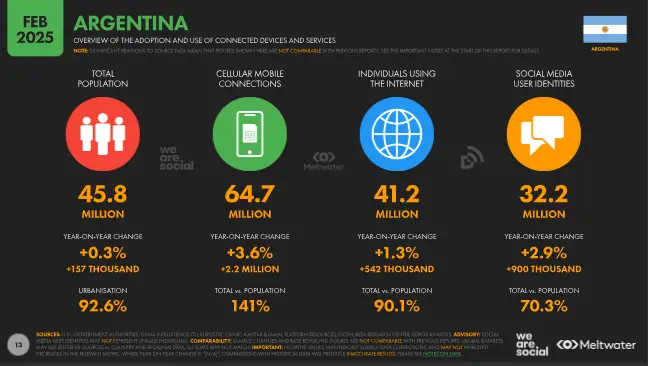
A total of 64.7 million mobile cellular connections were active in Argentina at the beginning of 2025, representing 141% of the total population. However, it should be noted that some of these connections may only include services such as voice and SMS, and some may not include internet access.

There were 41.2 million individuals using the internet in Argentina at the beginning of 2025, when online penetration was 90.1%.

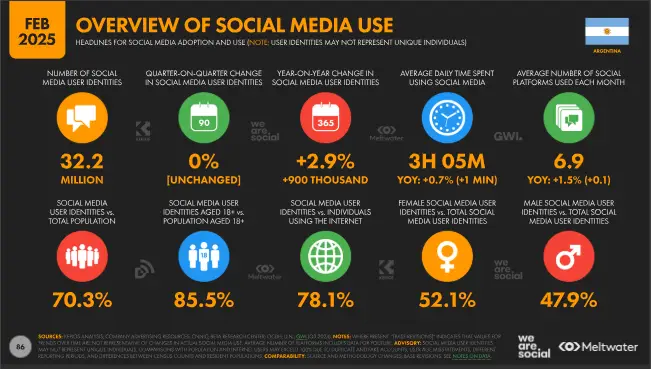
Argentina was home to 32.2 million social media user identities in January 2025, which is equivalent to 70.3% of the total population.

General summary of Internet use in Argentina

Internet use in Argentina

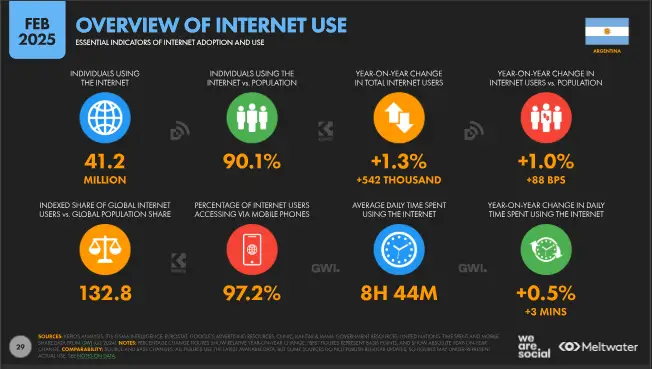
At the time of writing the report, the latest available data indicated that there were 41.2 million internet users in Argentina in January 2025.

This means that the internet penetration rate in Argentina stood at 90.1% of the total population at the beginning of the year.

Meanwhile, Kepios’ analysis indicates that the number of internet users in Argentina increased by 542,000 (+1.3%) between January 2024 and January 2025.

To add perspective, the Internet adoption rate in Argentina (i.e., the percentage of the total population using the Internet) increased by a relative 1% (+88 basis points) during the same period.

Use of social media in Argentina

Use of social media in Argentina

DataReportal figures show that in January 2025 there were 32.2 million active social media users in Argentina.

In perspective, this figure was equivalent to 70.3% of the total population of Argentina at the beginning of 2025.

Kepios’ analysis shows that social media user identities in Argentina increased by 900,000 (+2.9%) between early 2024 and early 2025.

Turning our attention back to user demographics, data published in the ad planning tools of major social media platforms indicates that there were 29.1 million users over the age of 18 using social media in Argentina at the beginning of 2025, which was equivalent to 85.5% of the total population aged 18 and over.

Most used Social Media Platforms in Argentina

Most used Social Media Platforms in Argentina

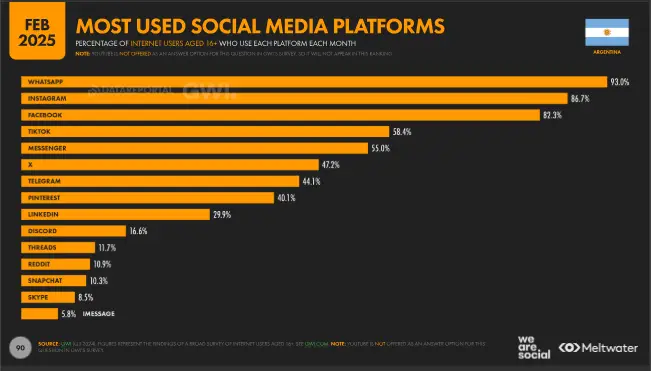
WhatsApp (93% of internet users) remains the most used platform in Argentina, among people aged 16 to 64.

TikTok continues to grow among the most used platforms, although it is still not close to the top 3. It ranks as the fourth most used platform (58.4%).

Facebook audience statistics

Facebook advertising in Argentina

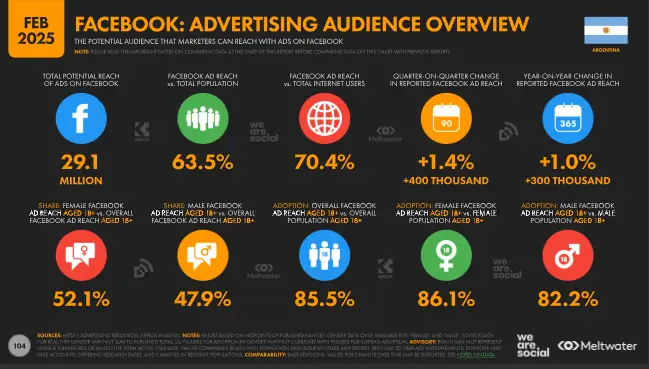
Data published in Meta’s advertising resources indicates that Facebook had 29.1 million users in Argentina at the beginning of 2025.

However, Meta has made significant changes to how its advertising resources report audience data in recent months – including making significant revisions to published audience data – so the figures shown here may not be directly comparable to those published in previous reports.

Figures published in Meta’s own tools indicate that the potential reach of Facebook ads in Argentina increased by 300,000 (+1%) between January 2024 and January 2025.

For a more recent context, the same data shows that the number of users that marketers could reach with Facebook ads in Argentina increased by 400,000 (+1.4%) in the three months between October 2024 and January 2025.

Instagram audience statistics

Instagram audience statistics in argentina

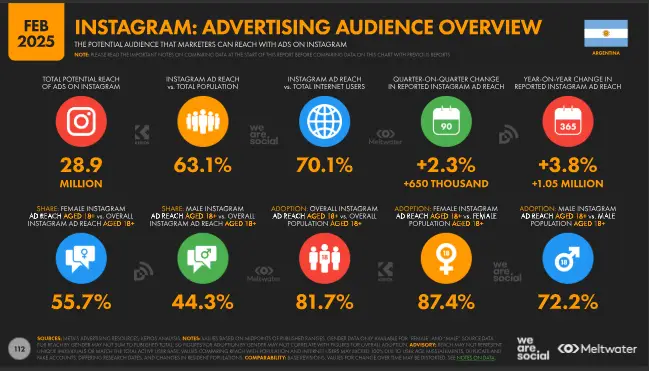
The numbers published in Meta’s advertising tools indicate that Instagram had 28.9 million users in Argentina at the beginning of 2025.

The company’s regularly reviewed figures suggest that Instagram’s ad reach in Argentina was equivalent to 63.1% of the total population at the beginning of the year.

However, Meta only allows people over the age of 13 to use Instagram, so it is also worth noting that 76.8% of the “eligible” audience in Argentina used Instagram at the time of the report’s production.

Data published in Meta’s planning tools shows that the potential reach of Instagram ads in Argentina increased by 1.05 million (+3.8%) between January 2024 and January 2025.

Quarterly, the company’s data also reveals that the size of Instagram’s ad audience in Argentina increased by 650,000 (+2.3%) between October 2024 and January 2025.

TikTok audience statistics

TikTok audience statistics in Argentina

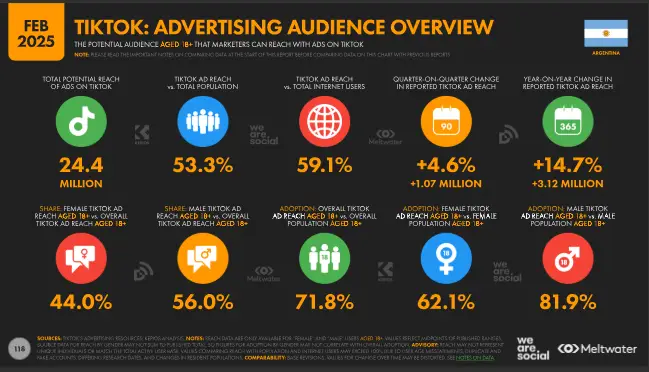
Figures published in TikTok’s advertising resources indicate that at the beginning of 2025 there were 24.4 million users over the age of 18 in Argentina.

TikTok allows marketers to target TikTok ads to users over the age of 13 through its advertising tools, but these tools only show audience data for users over the age of 18.

TikTok’s figures indicate that TikTok ads reached 71.8% of all adults over 18 years of age in Argentina by early 2025.

Data published in TikTok’s own advertising planning tools shows that TikTok’s potential advertising reach in Argentina increased by 3.12 million (+14.7%) between early 2024 and early 2025.

Meanwhile, the figures indicate that the potential reach of ads on TikTok in Argentina increased by 1.07 million (+4.6%) between October 2024 and January 2025.

LinkedIn audience statistics

LinkedIn audience statistics in Argentina

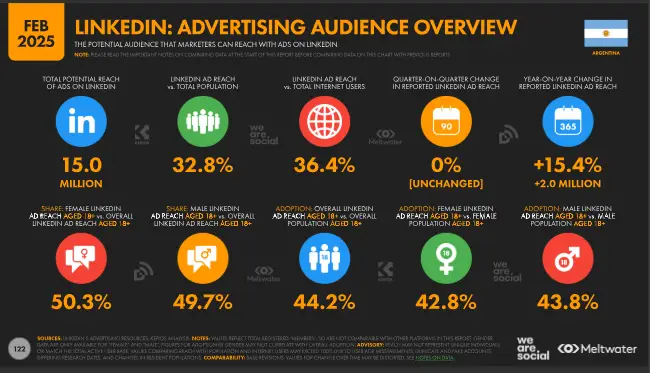
Data published in LinkedIn’s planning tools shows that the potential reach of LinkedIn ads in Argentina increased by 2 million (+15.4%) between the beginning of 2025 and the beginning of 2026.

Quarterly, the company’s data reveals that the audience size for LinkedIn ads in Argentina remained the same between October 2024 and January 2025.

Linkedin continue to be the most important B2B social media platform for every digital marketing agency specialized in corporate marketing

X (Twitter) audience statistics

X (Twitter) audience statistics in argentina

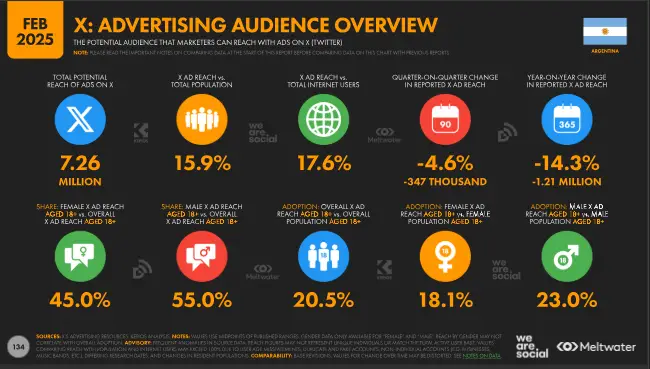
Data published in X’s own advertising planning tools shows that X’s potential advertising reach in Argentina decreased by 1.21 million (-14.3%) between early 2024 and early 2025.

Meanwhile, the same data shows that the number of users marketers could reach with ads on X in Argentina decreased by 347,000 (-4.6%) between October 2024 and January 2025.

However, it should be noted that the figures published in X’s planning tools are subject to significant fluctuations – even over short periods of time – and these anomalies can affect the reliability and representativeness of these change figures.

Digital Advertising Spending

Digital Advertising Spending in argentina
Digital Advertising in argentina

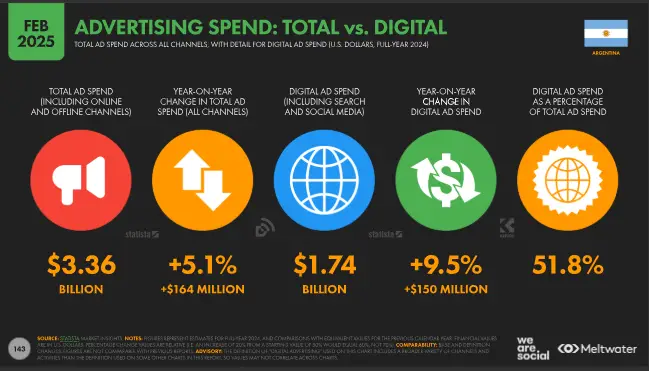
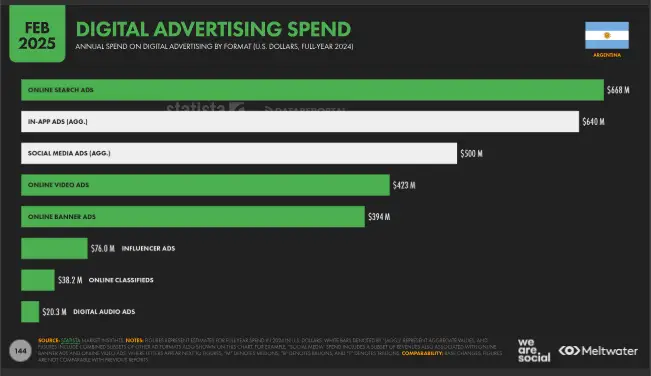
Spending on digital advertising increased by 9.5% in the last year. This equates to more than $150 million USD.

Of the total $1.74 trillion USD invested in digital advertising in 2024, the following is shown:

– $668 million USD was allocated to search engine campaigns.

– $423 million USD was spent on video advertising, while $394 million was spent on banner ads.

– $76 million USD was invested in influencer marketing.

– $38.2 million USD was spent on classified ads.

Source: Digital.

These statistics clearly demonstrate the importance of continuing to rely on a digital strategy agency for the development of any company in today’s world.

Read more Digital Marketing news.

Social Media Statistics Peru 2025

Estadísticas de Redes Sociales Perú 2025

We Are Social and Meltwater presented the updated report Digital 2025 on Social Media Statistics in Peru. We will discuss the data recorded on the digital situation in Peru in 2024-2025.

Use of Devices, Internet and Social Networks

Use of Devices, Internet and Social Networks

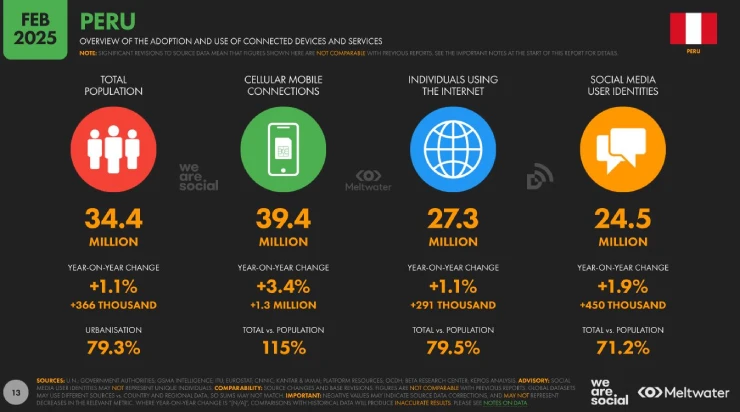
A total of 39.4 million mobile cellular connections were active in Peru at the beginning of 2025, equivalent to 115% of the total population. However, some of these connections may only include services such as voice and SMS, and some may not include internet access.

27.3 million people used the internet in Peru at the beginning of 2025, when online penetration was 79.5%.

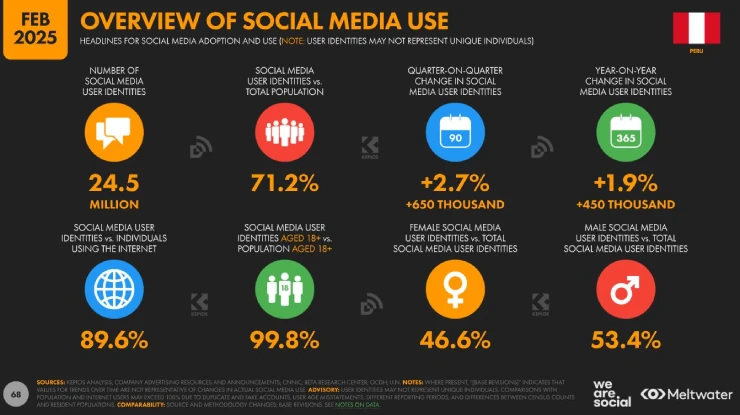
In January 2025, Peru had 24.5 million social media users, which is equivalent to 71.2% of the total population.

These main statistics offer a great overview of the “digital state” in Peru at the beginning of 2025, but to understand how digital trends and behaviors have evolved over time, we need to delve deeper into the data.

General Summary of Internet Use

Social Media Statistics Peru 2025

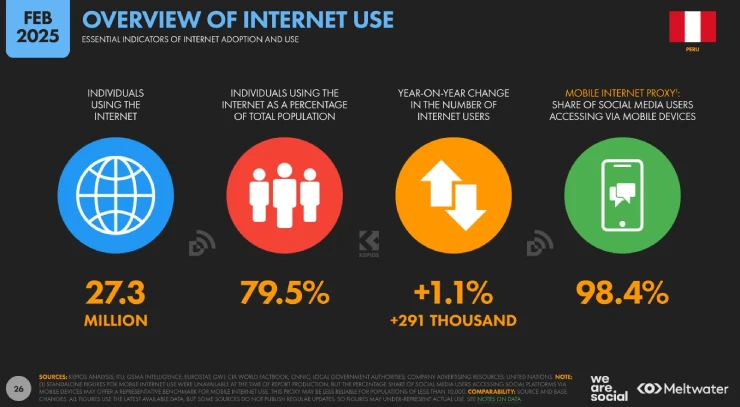
At the time of writing the report, the latest available data indicated that there were 27.3 million internet users in Peru in January 2025.

This means that the internet penetration rate in Peru was 79.5% of the total population at the beginning of the year.

Meanwhile, Kepios’ analysis indicates that the number of internet users in Peru increased by 291,000 (+1.1%) between January 2024 and January 2025.

Social Media Statistics Peru – General Summary of Social Media Use

Social Media Statistics Peru - General Summary of Social Media Use

DataReportal figures show that in January 2025 there were 24.5 million active social media users in Peru.

In perspective, this figure was equivalent to 71.2% of the total population at the beginning of 2025.

The analysis by Kepios shows that the identities of social media users in Peru increased by 450,000 (+1.9%) between the beginning of 2024 and the beginning of 2025.

Data published in the ad planning tools of major social media platforms indicates that there were 24.5 million users over the age of 18 using social media in Peru at the beginning of 2025, which was equivalent to 99.8% of the total population aged 18 and over.

At that time, 46.6 percent of social media user identities in Peru were female, while 53.4 percent were male.

And to add context, it may be helpful to know that 89.6% of Peru’s total internet user base (regardless of age) used at least one social media platform in January 2025.

Social Media Statistics Peru 2025 – YouTube Audience

YouTube Audience

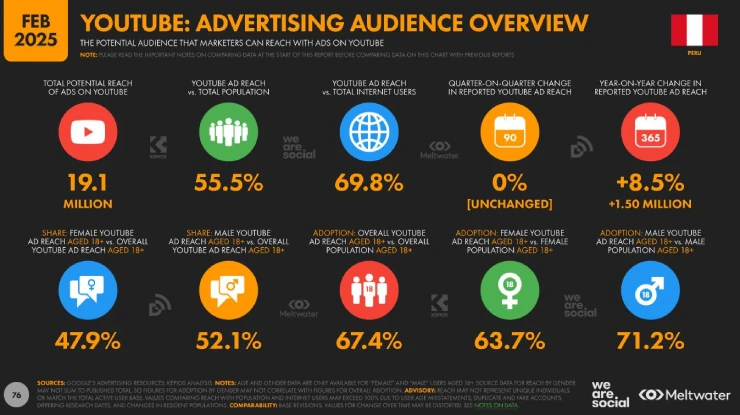
Google’s advertising resources indicate that YouTube had 19.1 million users in Peru at the beginning of 2025.

The company’s own data suggests that the reach of the YouTube ad in early 2025 was equivalent to 55.5 percent of the total population of Peru at the beginning of the year.

To put these figures into perspective, YouTube ads reached 69.8% of Peru’s total internet user base (regardless of age) in January 2025.

At that time, 47.9% of YouTube’s adult ad audience in Peru was female, while 52.1% was male.

Data published in Google’s own advertising planning tools shows that the potential reach of YouTube ads in Peru increased by 1.5 million (+8.5%) between early 2024 and early 2025.

Social Media Statistics Peru 2025 – Facebook Audience

Facebook Audience

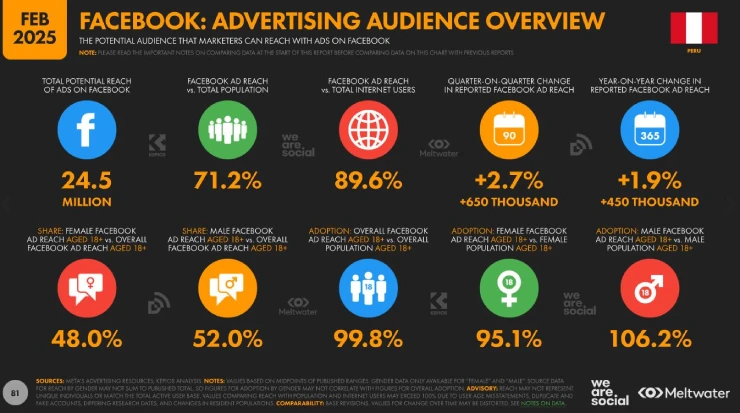
Figures published in Meta’s own tools indicate that the potential reach of Facebook ads in Peru increased by 450,000 (+1.9 percent) between January 2024 and January 2025.

In a more recent context, the same data shows that the number of users that marketers could reach with Facebook ads in Peru increased by 650,000 (+2.7%) in the three months between October 2024 and January 2025.

Facebook ads reached 71.2 percent of the total population in Peru at the beginning of 2025. This reach was equivalent to 89.6% of the local internet user base (regardless of age) in January 2025.

Social Media Statistics Peru 2025 – Instagarm Audience

Instagram Audience

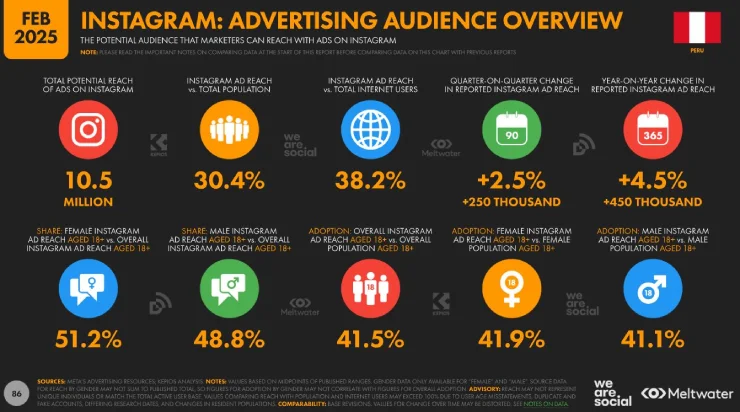
The numbers published in Meta’s advertising tools indicate that Instagram had 10.5 million users in Peru at the beginning of 2025.

The company’s regularly revised figures suggest that Instagram’s ad reach in Peru was equivalent to 30.4% of the total population at the beginning of the year.

Data published in Meta’s planning tools shows that the potential reach of Instagram ads in Peru increased by 450,000 (+4.5%) between January 2024 and January 2025.

Quarterly, the company’s data also reveals that the size of Instagram’s ad audience in Peru increased by 250,000 (+2.5%) between October 2024 and January 2025.

Social Media Statistics Peru 2025 – TikTok Audience

TikTok Audience

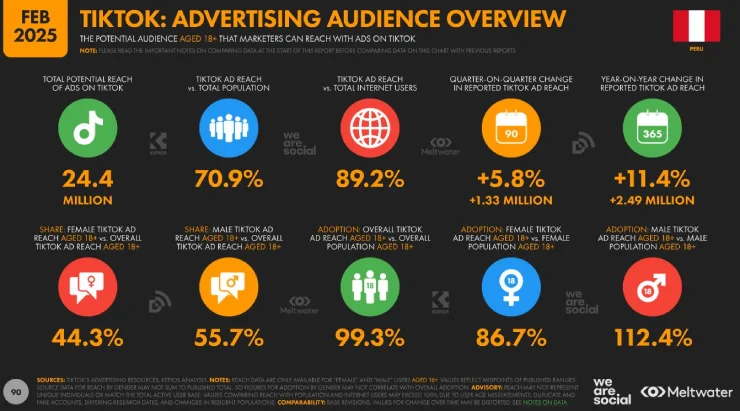
Data published in TikTok’s own advertising planning tools shows that TikTok’s potential advertising reach in Peru increased by 2.49 million (+11.4 percent) between early 2024 and early 2025.

Meanwhile, the figures indicate that the potential reach of ads on TikTok in Peru increased by 1.33 million (+5.8 percent) between October 2024 and January 2025.

Social Media Statistics Peru 2025 – Linkedin Audience

Linkedin Audience

LinkedIn continues to grow and consolidate its position as the most important B2B social media platform for the region.

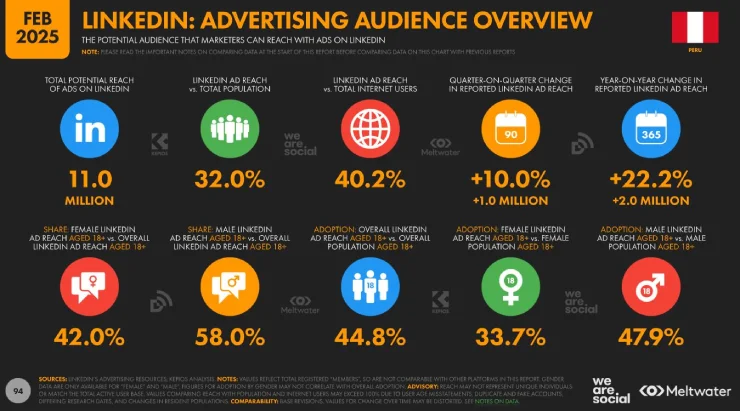
Data published in LinkedIn’s planning tools shows that the potential reach of LinkedIn ads in Peru increased by 2.0 million (+22.2%) between the beginning of 2024 and the beginning of 2025.

Quarterly, the company’s data reveals that the size of LinkedIn’s ad audience in Peru increased by 1 million (+10%) between October 2024 and January 2025.

It’s important to note that LinkedIn’s advertising tools publish audience reach data based on the total number of registered members, rather than the monthly active users that form the basis of ad reach figures published by most other social media platforms.

As a leading digital marketing agency in Latin America, we work with various companies in the planning and development of their digital strategies in the region. Whether they are B2B, B2C, small or large companies, we know how to use internet resources to boost their businesses.

Read more Digital Marketing News.

e-commerce in Argentina, 2020 brief

e-commerce in argentina

Year 2020 has undoubtedly been an atypical year for everyone and e-commerce in Argentina could not stay on the sidelines. Beyond the difficult economic situation the country is going through, this last year of the Pandemic has resulted in significant growth for online sales.

The year 2020 has been an unprecedented year for Argentines, as well as for the rest of the world. Our lives have changed and our shopping behaviors have changed too. And in a few months, a greater evolution has been achieved than in recent years when talking about companies digital transformation and e-commerce. From our Way2net digital marketing agency we can attest to this, since all our clients, regardless of the industry, have experienced great growth in their online sales.
ecommerce in Argentina

Let’s review some indicators that show this:

+58% of people do banking operations online or through the app (48% in 2019)

+48% watch on demand movies (40% in 2019)

+43% order food online (27% in 2019)

+34% buy food and beverages online (18% in 2019)

+1.28 million of online shoppers, for a total of 20.05 million (18.77 million in 2019)

facturacion 2020 e-commerce en argentina
Fuente CACE

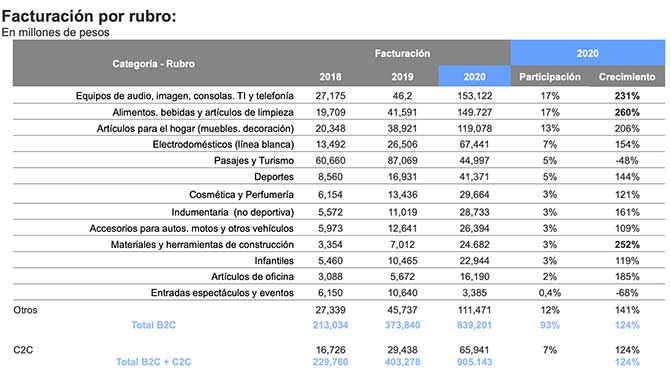
+124% growth in revenue ($ 905 million vs. $ 403 million in 2019)

6 out of 10 buy a product at least once a month. And half of post-pandemic online shoppers are already everyday or regular e-commerce users.

crecimiento e-commerce en Argentina
Fuente CACE

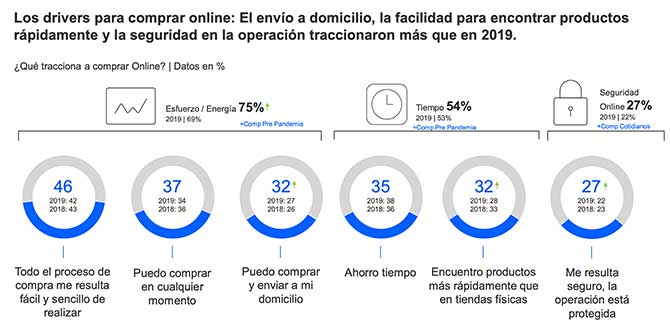
The key factors to buy online: Home delivery, the ease of finding products quickly and the safety of the operation were more powerful than in 2019.

However, not all that glitters is gold, and we can also mention the cons.

Main obstacles for e-commerce development of e-commerce in Argentina

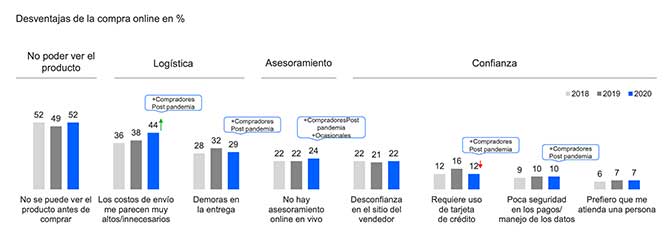
Shipping costs are the main barrier. Although many new players have appeared competing for services and rates, the cost of shipping in Argentina is still high.

Logistics and delivery delays are another factor mentioned.

Another important obstacle for consumers is not being able to see and touch the merchandise. Especially in some areas such as clothing, shoes and others, and especially when the customer does not know the brand that they are buying.

e-commerce en argentina problemas
Fuente CACE

On the business side, we can also mention that as there was greater competition and concentration of online sales, the costs associated with online advertising have also increased.

For some companies, it has also been a problem not to be prepared to face the online world, with a digital strategy already planned and underway.

How is the profile of the online consumer in Argentina?

In 2020 we find a more diversified buyer profile, with post-pandemic buyers entering the ecommerce world buying mobile, while more experienced buyers continue to use more desktop computers.

Another aspect that stands out is the change in the socio-economic profile of online shoppers. We went from the historic high and medium level to a more socio-economic profile in the medium and low segment. It is not that the high segment disappeared, but based on their experience they have expanded the categories that used to bought online, while the lower middle segment is more about a new consumer, who was not used to buying online.

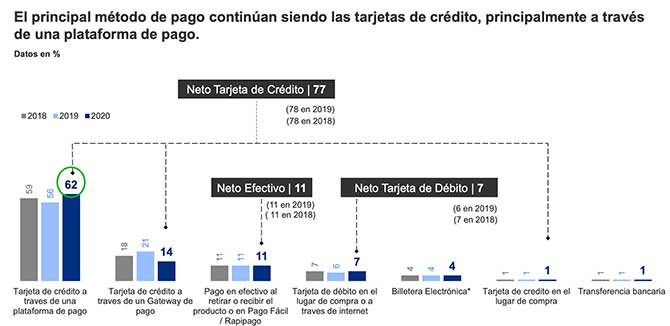
No major changes were observed with respect to the chosen payment method, and credit card is still the main method used.

principales medios de pago ecommerce en argentina

On the other hand, a great change was noticed in the chosen shipping method, as a result of the pandemic, where home delivery was positioned in the first place, displacing the picking in store that had been leading in previous years.

Main industries e-commerce in Argentina 2020

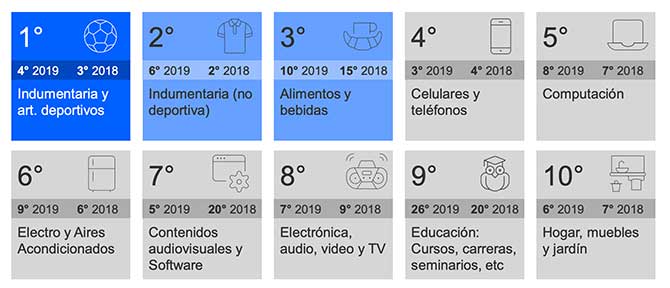
Sportswear, clothing and food and beverages are the TOP3 of the most popular categories among Argentines for this 2020. Food and beverages climbed 7 positions in the year of the pandemic. Then followed closely by Technology and Electro.

principales rubros de e-commerce en Argentina 2020
Fuente CACE

For the first time in many years, COVID-19 has eliminated tourism and entertainment from the ranking of first time purchased categories, giving the place to categories related to food, home conditioning, personal care, courses, careers, seminars, among others.

We will see what awaits us in 2021, but everything suggests that we will have another year where e-commerce development will once again be one of the stars in this adverse economic context

Data Source CACE

Way2net awarded as Top Digital Marketing Agency in Argentina

Way2net awarded as Top Digital Marketing Agency in Argentina

Way2net is a digital marketing agency, specialized in e-strategy planning and business development, digital marketing, online advertising, web optimization, social media, web design, and development. We are a Google Partner Agency certified by Google Inc. and we offer a wide variety of services including digital strategy, social media marketing, and advertising.

Clutch recently announced the top digital marketing agencies in Argentina. We are excited to announce that Way2net has made the list on their directory.

Way2net awarded as Top Digital Marketing Agency in Argentina

Clutch is a B2B market research firm located in Washington DC that connects service providers and buyers through data and verified research. Central to their process is client reviews. In this unique process, analysts have spoken directly with many of our clients and learned more about the services we provided, as well as technological capabilities, results, and business acumen.

Our clients’ participation made this award possible, and we want to thank them for their time and honest feedback. Below is are excerpts from recent reviews, along with project summaries:

“We continue working with them because of their thoughtful service.” –Marketing Coordinator, Synthon Bagó

Our team was hired to develop a pharmaceutical company’s marketing strategies. We work with different social media channels, crafting campaigns. We also worked on their site.

“With Way2net Digital Marketing Agency, we found a mix of business expertise and digital experience.” –Founder, Delbazar

We provided a variety of digital services for an online store. Our team developed an e-commerce website and social media campaigns

Digital marketing has forever changed how companies attract customers and generate revenue. If you’re considering hiring an online marketing company to help you boost your brand image, position your company in search rankings, or manage your social media presence, The Manifest can help find a business to best suit your needs. The Manifest, an affiliate site of Clutch, lists top digital marketing companies in Argentina. Among top companies, the site also lists descriptions, projects, and awards for users to utilize.

Need advice in marketing and communication? We are experts in digital strategy. Contact us by phone or fill out the form on our website and a team member will be in touch shortly. We look forward to hearing from you and your team.

The main benefits of WooCommerce for startups

benefits of WooCommerce

benefits of WooCommerceWooCommerce is a WordPress plugin that is ideal for ecommerce retailers just starting out. It is simple enough to learn, pretty powerful, and you cannot beat the price – it is free.

Let’s check main benefits of WooCommerce:

It is free to download: There are many different CMS systems available and they are great. The drawback with a lot of these, however, is the price.

It is easy to use and flexible: You can easily add categories, change prices, etc, even if you have very little technical know-how. It is WordPress based so if you are familiar with WordPress, you will adapt quickly. You can also link into virtual products.

Build a professional looking store: You can use WooCommerce to build an ecommerce platform that looks professionally designed on your own site.

You can customize it a lot: There are a lot of different customization options that you can use to help your site stand out. Strangely, for a free plugin, you have a wide range of themes to choose from. Choose any of the 39 themes from WooThemes to get started. Unlike some other themes, you are able to change preset colors, CSS styles, and coding.

A full platform: It is a completely functional, professional ecommerce platform. It’s safe to say that besides some good WordPress hosting (and WordPress itself, of course), WooCommerce is all you really need to start making money off your website right away.

You are able to access various analytics and make use of tracking, tools to boost customer engagement, apply the discounts you like, and keep your clients up to date when it comes to the status of their orders. It allows you all the functions of many of the expensive paid options and quite a few more.

Analytics built-in: You can choose to make use of the analytics built into the system to track sales, average order totals, client statistics, etc. from the admin panel. The information is presented in an easy to understand style.

Many apps and extensions: There are a whole host of apps and extensions that can be used to increase the functionality of your WooCommerce site. Some of these can be downloaded free of charge, like Google Analytics, others you have to pay for. With the add of the apps, you can get all the information and functionality you might possibly want without having to click out of your admin page.

WooCommerce is a plugin that will prove worth its weight in gold. It is ideal for a startup because it offers such a wide range of features and a lot of support. It is also a well-known plugin between leading digital marketing agencies.

Sources:

https://websitebuilder.org/Facts-You-Need-to-Know-About-WooCommerce