
Online Marketing

Way2net » Online Marketing

2026 Report: Digital Marketing in Argentine SMEs

¿Cuánto invierten las PyMEs argentinas en marketing digital?

How much do Argentine SMEs invest in digital marketing? Which channels do they use? What results are they achieving? And how are they incorporating artificial intelligence into their marketing strategies?

By Cesar Fernandez | Director, Way2net Digital Marketing Agency | August 2026

Key Digital Marketing Data from Argentine SMEs in 2026

IndicatorResult
Companies surveyed187
Average monthly investmentUSD 1,847
Median monthly investmentUSD 780
Use Meta Ads73%
Use Google Ads61%
Use SEO44%
Do not clearly measure ROI46%
Use generative AI64%
Plan to increase SEO investment42%
Plan to increase GEO investment22%

When you ask an SME how much it spends on digital marketing, the first response is often silence. Then comes a number that usually underestimates the real investment, because nobody adds up the email platform, design tools, community manager hours, and the Meta campaign that has been running for three months without being reviewed.

This disconnect between what companies think they invest and what they actually spend was the starting point for this study.

At Way2net, we have been working with Argentine SMEs for more than 15 years, and one of the most common conversations during initial meetings with new clients is precisely this: “I don’t really know how much we’re spending on marketing, and I’m not sure whether it’s working.”

Between February and July 2026, we surveyed 187 SMEs from different industries and company sizes to understand how much they actually invest in digital marketing, which channels receive most of their budget, what results they perceive, and what their main obstacles are.

¿Cuánto invierten las PyMEs argentinas en marketing digital?

The results confirm some common assumptions while challenging others.

7 Key Findings from the Study

  1. The median monthly digital marketing investment among surveyed SMEs is USD 780.
  2. Meta Ads is the most widely adopted channel.
  3. Google Ads remains essential for capturing existing demand.
  4. SEO has lower adoption but a stronger perception of long-term ROI.
  5. Almost half of companies do not properly measure their return on investment.
  6. Generative AI is already being incorporated into marketing teams.
  7. GEO is beginning to emerge as a new area of investment.

Methodology

The research was conducted through semi-structured interviews and an online questionnaire distributed among Way2net’s active and former clients, as well as through a network of business contacts.

The resulting sample is not representative of the entire Argentine SME sector. It is biased toward companies that already have some level of digital presence and have generally already decided to invest in digital channels.

This is important when interpreting the figures: companies that have not yet invested anything in digital marketing are not represented in the sample.

Sixty-three percent of participants are located in the Buenos Aires metropolitan area. The remainder are distributed across Córdoba (11%), Rosario (8%), and other provinces.

In terms of company size, 48% have between 5 and 25 employees, 34% between 26 and 100, and the remaining 18% have more than 100 employees, although this last group is at the upper limit of what is commonly considered an SME.

The most represented industries were professional services (22%), technology and software (18%), retail and commerce (16%), hospitality and gastronomy (13%), healthcare (11%), and education (9%).

How Much Do Argentine SMEs Invest?

The average monthly digital marketing investment among the surveyed SMEs is USD 1,847.

However, this number only makes sense when looking at the distribution, because the average is influenced by a relatively small group of companies with significantly larger budgets.

The median is USD 780, which provides a more representative picture of what the “middle” company in the sample invests.

The complete distribution reveals four distinct investment groups:

  • Minimal investment — less than USD 800/month: 19% of respondents. This generally corresponds to very small companies or businesses with an early-stage digital presence. Spending is concentrated on a single platform, usually Meta.
  • Basic investment — USD 800 to USD 2,000/month: 31%. This is the largest segment. These companies typically run Meta or Google Ads campaigns but have little or no investment in SEO, GEO, or an integrated marketing strategy.
  • Medium investment — USD 2,000 to USD 3,500/month: 28%. Multichannel activity starts to become more common, combining paid advertising with SEO or social media management.
  • High investment — more than USD 3,500/month: 22%. These companies generally operate in highly competitive industries or have larger teams. They either work with an agency or have at least one internal marketing professional.

One particularly interesting finding is that 10% of respondents invest more than USD 5,000 per month in digital marketing.

These are not necessarily large corporations. They include SMEs operating in highly competitive industries such as fintech, B2B software, construction materials, and premium tourism, where the value of a new customer can justify a significant investment or where digital has become one of their main sources of new business.

“We started by spending USD 400 a month on Meta and thought that was a lot. When we calculated what a new customer was worth, we realized that ten new customers a month would pay for that investment within the first week.”

— Sales Manager, SaaS company, Buenos Aires

Which Digital Marketing Channels Are Argentine SMEs Using?

The most widely adopted channel is Meta Ads (Facebook and Instagram), used by 73% of respondents.

It is followed by Google Ads at 61%.

Organic SEO ranks third, with 44% adoption, while email marketing —which was significantly more relevant five years ago— ranks fourth at 29%.

The adoption of GEO strategies, focused on improving visibility in AI-powered search and answer engines, is still at an early stage.

Among companies using multiple channels, the average budget distribution is:

  • Google Ads: 36%
  • Meta Ads: 31%
  • SEO and content: 19%
  • Web design and development: 8%
  • Email marketing and automation: 6%

What stands out is not necessarily which channel receives the largest budget, but the gap between investment and perceived return.

In open-ended responses, SEO was frequently identified as the channel with the best long-term ROI among companies that work on it consistently —yet it remains the third most widely adopted channel.

The most common explanation was simple:

“It takes time to see results, and we don’t have the patience for it.”

Google Ads can generate results quickly, but customer acquisition costs tend to increase over time. Companies that have been running Ads for more than 18 months without investing in SEO show, on average, a 40% higher cost per lead (CPL) than companies combining both channels.

The Specific Case of Meta Ads

Meta remains the entry point for most Argentine SMEs for two very practical reasons: the barrier to entry is low, and interest-based targeting makes it possible to reach reasonably relevant audiences without a complex technical infrastructure.

However, 54% of companies using Meta acknowledge that they have not properly configured their tracking pixel or do not have reliable conversion data.

They are investing —sometimes several thousand dollars per month— without knowing whether sales are actually coming from that investment or from another source.

This is one of the most common structural problems among SMEs: platforms make it extremely easy to start advertising, but that simplicity can lead companies to overlook basic measurement and tracking.

Without reliable conversion data, optimization is essentially done blind.

Differences by Industry: Not All Businesses Are the Same

Technology and software, together with construction materials, lead in average investment at USD 2,340 per month and in SEO adoption at 68%.

This makes sense: these companies tend to understand the channel, their customers actively search for their solutions on Google, and the value of a contract justifies sustained investment in organic visibility.

Professional services —including accounting firms, law firms, and consultancies— show the strongest year-over-year growth, with average budgets up 47% compared with 2025.

The explanation is straightforward: after the pandemic, these professionals increasingly understood the importance of online reputation, while competition on Google became more intense.

At the opposite end, gastronomy has the lowest average budget at USD 420 per month and the highest concentration in a single channel, Meta.

This does not necessarily mean that the investment is inefficient. In gastronomy, Instagram continues to have a major influence on the decision to visit a restaurant or venue. Rather, the business model leaves less room to experiment with multiple channels.

An interesting finding is that retail has the highest adoption of Meta Ads at 83%, but also some of the lowest satisfaction levels with results.

Competition for consumer products on Meta is intense, CPMs increased significantly during 2025–2026, and the algorithm increasingly favors accounts with large volumes of conversion data —which are generally the larger companies.

The ROI Problem: Who Measures It and Who Doesn’t?

Forty-six percent of respondents acknowledge that they do not have clear metrics for measuring their digital marketing ROI.

This does not necessarily mean their results are poor. In many cases, the business is growing, but attribution is not properly configured to determine how much of that growth comes from digital channels.

Among companies that do measure ROI, the reported averages are:

  • Google Ads (SEM): 2.9x during the first year
  • Organic SEO: 1.6x during the first year and 4.2x by the third year
  • Meta Ads: 2.1x, with significant variation between companies

The difference between SEO’s first and third year is particularly relevant.

The channel tends to generate a lower return during the first year and a substantially higher return over time because the content and authority built through SEO can continue generating traffic without requiring an equivalent increase in media spend.

However, this data should also be interpreted carefully.

Companies that measure ROI correctly tend to have a higher level of digital maturity. Therefore, the figures may be subject to selection bias: companies that measure their results may be more likely to do so because they are already achieving positive outcomes.

Inflation and the Exchange Rate: Permanent Distortions

Sixty-seven percent of respondents identify exchange-rate volatility as the main obstacle to planning digital marketing investment.

This is not a minor issue.

Advertising platforms charge in US dollars, while many Argentine businesses generate revenue in Argentine pesos. When the exchange rate changes, a budget that covered USD 1,000 the previous month may no longer provide the same level of investment.

This creates a very Argentine behavior: 38% of surveyed SMEs adjust their marketing budget every month depending on exchange-rate conditions, rather than maintaining a stable investment.

The problem is that advertising platforms need consistency to optimize.

An account that constantly increases and decreases its budget may never complete the learning phase and therefore may never reach its full potential.

Companies that manage this constraint more effectively tend to be those that have dollarized their pricing or operate in businesses where revenue is linked to the dollar, such as real estate, or those that rely more heavily on channels that do not require continuous media spending, such as organic SEO.

“We decided to keep our Google Ads investment stable in dollars, even if that sometimes means adjusting other areas. The alternative —constantly increasing and decreasing the budget— is worse. We lose the position we have built and then it becomes more expensive to recover it.”

— Marketing Manager, financial services company, Buenos Aires

What Do the Best-Performing SMEs Do Differently?

Among companies investing more than USD 2,000 per month and reporting satisfactory results, several consistent patterns emerge.

They measure from the beginning

Before launching campaigns, they have conversion tracking configured.

They do not start advertising and only later try to understand what worked.

Meta’s tracking pixel, Google Ads tags, and Google Analytics 4 are properly connected from day one.

They combine paid media with SEO

Seventy-nine percent of this group works simultaneously with paid advertising and SEO, compared with 31% of the rest of the sample.

They do not necessarily do this because of theoretical sophistication. Rather, they have learned from experience that when paid campaigns stop —because of budget constraints, account suspensions, or other issues— organic traffic can continue generating opportunities.

They work with stable providers

Only 12% of this group changed agencies or freelancers during the previous 12 months, compared with 34% among lower-investment companies.

Constantly changing providers means repeatedly starting from zero in terms of business knowledge.

Digital marketing requires accumulated learning to improve performance over time.

They have an internal person responsible for the channel

This does not necessarily mean having a full marketing team.

However, there is usually someone inside the company who reviews reports, has access to the accounts, and acts as the main point of contact with the agency.

Companies where “the agency handles all the marketing and nobody internally supervises it” are more vulnerable to inefficient investment.

They plan by quarters, not months

Instead of deciding the marketing budget month by month based on immediate business performance, these companies plan quarterly and maintain their investment even when a particular month is weaker.

They understand that digital marketing works through accumulated learning and optimization: weaker months are part of the process and are not necessarily evidence that a channel does not work.

¿Cuánto invierten las PyMEs argentinas en marketing digital en 2026?

The Most Common Mistakes Among SMEs That Invest but Don’t See Results

Beyond measurement problems, several recurring mistakes emerged among companies reporting weaker results.

Investing in paid advertising without fixing the website

Forty-one percent of companies spending more than USD 500 per month on Google Ads have websites that do not pass Google’s Core Web Vitals.

In other words, they have issues related to mobile loading speed, interactivity, or visual stability.

Sending paid traffic to a slow website is like filling a bucket with holes.

Not having dedicated landing pages

Fifty-seven percent of companies running Ads send traffic to their homepage instead of a conversion-focused landing page.

A homepage is designed to provide general context about a company. It is not necessarily designed to convert a specific search intent into a lead or sale.

Using Meta to sell directly when the product requires education

Some products and services require potential customers to understand why they need them before considering a purchase.

Meta can be effective for generating awareness and capturing demand, but it is not always the best channel for latent demand that needs to be educated.

In these cases, content SEO and Google Search Ads can often be more appropriate.

Not investing in creative assets

Meta campaigns depend heavily on the quality of graphic and video content.

Forty-eight percent of respondents acknowledge using generic creatives or failing to refresh them for more than three months.

The algorithm rewards novelty: when the same creative stops generating engagement, audience response declines and CPMs can increase.

Sixty-one percent of respondents plan to maintain or increase their digital marketing budget during the second half of 2026.

Twenty-four percent plan to maintain their current budget, while only 15% expect to reduce it.

The channels expected to see the strongest growth are:

  • SEO: 42% plan to increase investment.
  • Short-form video for social media: 38%.
  • GEO —optimization for AI-powered search and answer engines such as ChatGPT and Google AI Overviews: 22%.

The last figure is particularly significant because, only 12 months ago, very few Argentine SMEs were familiar with the concept of GEO.

Artificial intelligence is changing not only how people search for information, but also how companies create content.

Sixty-four percent of respondents already use some form of generative AI to produce marketing content.

However, AI usage does not automatically translate into better content.

Mass-produced AI content without editorial review can have the opposite effect, creating generic, low-value material that fails to demonstrate expertise or satisfy users’ needs.

Conclusions and Recommendations

The findings of this study point to several clear conclusions for Argentine SMEs looking to invest more effectively in digital marketing.

The median investment is around USD 780 per month, but this number only makes sense when accompanied by proper measurement. Without conversion tracking, any investment is effectively spending with an unknown return.

SEO remains one of the channels with the strongest long-term economics, but it requires consistency and time. SMEs that started investing in SEO two or three years ago are now seeing results that companies postponing the channel cannot reproduce overnight.

Inflation and exchange-rate volatility are genuine obstacles, but companies that manage them best tend to be those that planned their investment in dollar terms from the beginning and maintained consistency despite economic uncertainty.

And the most widespread problem is not necessarily budget.

It is the lack of measurement.

A smaller budget that is properly measured and optimized can outperform a larger budget managed without reliable data.

If you want to evaluate how your company compares with these benchmarks, we can provide a free digital marketing assessment.

Frequently Asked Questions About Digital Marketing Investment for SMEs

How much should an Argentine SME invest in digital marketing?

There is no universal budget. In Way2net’s study of 187 Argentine SMEs, the median monthly digital marketing investment was USD 780, while the average reached USD 1,847.
The appropriate budget depends on the industry, competitive environment, sales cycle, customer value, and business objectives.
For paid advertising and SEO, the key is to have enough budget to sustain the strategy and measure its results.

Which digital marketing channel works best for SMEs?

It depends on the industry, sales cycle, and whether the product already has existing demand or needs to be created.
If customers actively search for what you sell, Google Ads and SEO can be a particularly effective combination.
If the product needs to be visually demonstrated or the audience does not yet know they need it, Meta Ads can work well as an awareness and demand-generation channel.
For most businesses, however, a combination of channels is more effective than relying on a single platform.

How long does it take to see an ROI from digital marketing?

The timeline varies depending on the website’s starting point, competition, search demand, and type of strategy.
Paid campaigns can generate data and conversions relatively quickly, while SEO generally requires sustained investment to build authority and organic visibility.
Google Ads and Meta Ads can begin generating results during the first month, although meaningful optimization generally takes between 60 and 90 days.
This is why a combination of paid media and SEO can be particularly effective: paid advertising generates faster results while organic visibility develops over time.

Should an SME hire a digital marketing agency or manage everything in-house?

t depends on the company’s workload, campaign complexity, budget, and internal capabilities.
An agency provides access to specialized professionals without requiring the company to hire every role individually. An internal team may make more sense once there is enough volume, budget, and operational complexity to justify a dedicated marketing department.
For many SMEs, working with an agency can be more efficient until the volume of work justifies building a full internal team.

How can I tell whether my digital marketing agency is doing a good job?

The basic KPIs to review every month include:
– Cost per lead or cost per sale.
– Traffic conversion rate.
– Google rankings for strategic keywords.
– Organic traffic as a percentage of total traffic.
– Leads and sales generated by each channel.

If your agency does not clearly report these metrics in context —rather than simply providing screenshots from Analytics— that should be a warning sign.

How much do Argentine SMEs invest in digital marketing?

According to Way2net’s 2026 study of 187 Argentine SMEs, the median monthly digital marketing investment was USD 780, while the average reached USD 1,847.

Which digital marketing channels are most widely used by Argentine SMEs?

In Way2net’s sample, Meta Ads was used by 73% of companies, Google Ads by 61%, and SEO by 44%.

How many SMEs use artificial intelligence in marketing?

Sixty-four percent of the companies surveyed reported using generative artificial intelligence tools for marketing-related activities.

About the Author

Cesar Fernandez is the founder and director of Way2net, a digital marketing agency with more than 15 years of experience operating in Argentina, the United States, and Latin America.

He has managed more than USD 95 million in digital advertising investment and has worked with companies across industries including software, fintech, retail, healthcare, construction, and tourism.

He writes about digital strategy, SEO, AI visibility, and marketing trends in Argentina and Latin America.O y tendencias del mercado argentino.
Social media trends 2026

Tendencias en redes sociales 2026 en Latinoamérica
Social media trends 2026 and the evolution of digital marketing in Latin America

Talking about social media trends in 2026 is no longer an exercise in creative anticipation, but a strategic necessity for companies operating in Latin America. The digital ecosystem is undergoing a period of accelerated maturation: more platforms, more formats, more content… and, paradoxically, less available attention.

Over the past few years, many brands have successfully established a strong presence on social media. However, the current landscape presents a different challenge: simply being present is no longer enough; brands must generate real, measurable, and sustained impact. Changes in algorithms, content saturation, audience fragmentation, and the widespread adoption of artificial intelligence are redefining how companies plan, produce, and evaluate their social media strategies.

In this scenario, the Social Media Study 2026 by Cyberclick and Metricool functions as an accurate thermometer of the market. Based on the insights of professionals in the digital ecosystem and the analysis of millions of posts, the report identifies clear patterns regarding what is working, what is losing relevance, and where social media marketing is headed.

From Way2net, as agency specializing in digital marketing and social media for growing companies in Latin America, we took this study as a trigger to go a step further: interpreting the data, translating it into strategic decisions and providing an applied perspective to the business.

This article isn’t about listing passing fads. Its goal is to help you understand which social media trends will define 2026, how they’ll impact businesses in the region, and what brands that want to remain competitive tomorrow should do today.

The current context of social media in Latin America

Before analyzing specific trends, it is key to understand the starting point. Social media in Latin America presents a unique combination of high adoption, a wide diversity of markets, and varying levels of digital maturity.

Las empresas de la región comparten varios rasgos comunes:

  • Intensive use of Instagram, Facebook and, increasingly, TikTok and LinkedIn
  • Sustained growth of video as the dominant format
  • Tight budgets versus high-performance expectations
  • Smaller marketing teams, with strong pressure for results
  • Increasing adoption of artificial intelligence tools

This context explains why many strategic decisions in social media are no longer made based on intuition, but rather on actual performance. And this is where the study becomes especially relevant: it shows how professionals are adjusting their priorities based on concrete data.

Social media strategy for businesses in Latin America

Trend 1: From content to performance as a strategic focus

One of the clearest conclusions of the study is that social networks have ceased to be solely a visibility channel and have become a business asset.

While brand awareness remains the primary objective, goals such as the following are growing strongly:

This marks a profound change: in 2026, successful social media strategies will be those that manage to balance branding and performance, without falling into extremes.

From Way2net’s perspective, this trend implies a key adjustment: each social network must fulfill a specific role within the funnel, and each piece of content must respond to a clear objective. Publishing without a defined strategic intention increasingly translates into a waste of resources.


Trend 2: Instagram continues to lead, but it’s no longer alone

Among the top social media trends for 2026, Instagram continues to occupy a central place in brand strategies in Latin America. Its strength lies in the balance between:

  • Organic reach
  • Variety of formats
  • Community
  • Advertising ecosystem

However, Instagram’s leadership is no longer absolute. Other platforms are gaining ground with very clear value propositions.

TikTok: growth, reach and discovery

TikTok is consolidating its position as the fastest-growing social network in terms of relevance by 2026. Its discovery-oriented algorithm and its dominance of short videos make it a key channel for brands seeking:

  • Massive reach
  • Rapid awareness
  • Connecting with younger audiences

For many Latin American companies, the challenge is not technical, but cultural: adapting the tone, language, and narrative to a platform that rewards authenticity over perfect aesthetics.

LinkedIn: the big winner in B2B

Another clear trend is the strengthening of LinkedIn as a strategic network for B2B companies. By 2026, LinkedIn will cease to be just a professional network and will become an active channel for demand generation, brand positioning, and thought leadership.

At Way2net we observe that more and more companies in Latin America are achieving concrete results when they combine:

  • Valuable content
  • Visible executive voices
  • Organic strategy + paid media

Trend 3: Short video ceases to be a trend and becomes infrastructure

If there’s one undisputed trend in social media for 2026, it’s the absolute dominance of short videos. Reels, Shorts, and TikToks are no longer a “format to try,” but the backbone of digital content.

The data shows that:

  • It is the format that generates the greatest reach
  • It’s the one that generates the most engagement.
  • It is the one most favored by the algorithms

This has direct implications for businesses:

  • Change the content planning
  • It affects the necessary resources
  • It forces us to rethink creativity

From a strategic perspective, the challenge is not to produce more videos, but to produce better videos, with a clear message, aligned with the business and designed to capture attention in the first few seconds.

Short video as the main trend on social media in 2026

Trend 4: Content saturation and falling engagement

Paradoxically, while content production is increasing, average output is decreasing. Saturation appears to be the main challenge for 2026.

This translates to:

  • Lower organic reach
  • Fewer interactions per post
  • Increased competition for attention

The strategic takeaway is clear: publishing more no longer guarantees better results. In many cases, the opposite is true.

For brands in Latin America, this trend forces them to make difficult but necessary decisions:

  • Reduce platforms
  • Prioritize formats
  • Prioritize quality over quantity

At Way2net, we approach this scenario with a clear focus: less noise and more relevance. Differentiation is no longer about frequency, but about the real value that each piece of content brings.

Use of artificial intelligence in social media and digital marketing 2026

Trend 5: Artificial intelligence is becoming part of everyday life

Another major trend in social media for 2026 is the consolidation of artificial intelligence as an operational tool. Most professionals already use it for:

  • Copywriting
  • Content planning
  • Image and video creation
  • Data analysis

However, the real difference lies not in using AI, but in how it is used to provide digital marketing services for companies.

From a strategic perspective, AI:

  • Increase efficiency
  • Reduce operating times
  • Free up resources to think more strategically

But it also presents risks: homogenization of content, loss of identity, and saturation of generic messages.

At this point, Way2net’s vision is clear: AI should function as a strategic ally, not as a substitute for human judgment. The brands that manage to combine technology, creativity, and business acumen will be the ones that stand out in 2026.

Trend 6: Authenticity and User-Generated Content (UGC)

In an increasingly automated environment, authenticity is becoming a key differentiator. The study shows a growing interest in user-generated content, real testimonials, and more human formats.

The brands that best connect with their audiences are those that:

  • They humanize their communication
  • They show real processes
  • They prioritize closeness over perfection

For companies in Latin America, this trend represents a concrete opportunity to compete with tighter budgets, focusing on credibility and approachability instead of overly polished productions.

What should companies do today to prepare for 2026?

Based on the analysis of these trends, some clear lines of action emerge:

  1. Define which networks bring real value to the business
  2. Assign a strategic role to each platform
  3. Opt for short videos with a focus on message and objective
  4. Use AI to gain efficiency, not to lose identity
  5. Prioritize engagement and relevance over volume
  6. Measure, adjust, and optimize constantly

The role of an expert social media agency in this new scenario

The social media trends for 2026 present a more complex, competitive, and demanding landscape than ever before. For many companies, the main challenge is not execution, but making the right decisions.

This is where the support of a specialized social media agency makes sense. Not to “publish for the sake of publishing,” but to:

At Way2net, we support Latin American companies in navigating this context with a strategic approach, offering data-driven marketing services geared towards sustainable growth.


Conclusion: 2026 is not about doing more, but about doing better

Social media trends for 2026 don’t point to a sudden revolution, but rather to the channel’s definitive maturation. Less improvisation, more strategy. Less volume, more intention. Less ego, more value for the audience.

Brands that understand this shift will not only survive the digital noise, but will also build strong relationships, measurable results, and a relevant presence in the long term.


Do you want to prepare your social media strategy for 2026?

At Way2net we help companies in Latin America transform trends into actionable strategies, aligned with business objectives.

Contact Way2net and let’s talk about how to boost your social media strategy for 2026.

See more news from digital marketing trends and analysis

Top 20 Best Digital Marketing Agencies in Argentina (2026)

mejores agencias de marketing en Argentina

The 20 Best Digital Marketing Agencies in Argentina (2026): Take Your Business to the Next Level

In today’s digital age, every business, large, medium, or small, needs to stand out in a sea of ??competition. The key to achieving this lies in an effective and well-executed digital marketing strategy. In Argentina, the digital marketing landscape is brimming with talented and creative agencies that can take your brand to the next level. From search engine optimization to social media management, these agencies offer a range of services that can be tailored to your specific business needs. But how do you choose the best option among so many alternatives?

Below is a selection of the 20 best advertising agencies in Argentina, each distinguished by its innovation, experience, and results. Discover how these agencies can propel your business to success and help you navigate the ever-changing digital world.

Introduction to digital marketing in Argentina

Over the past decade, digital marketing has revolutionized how businesses communicate with their customers and promote their products and services. Argentina is no exception. With growing internet penetration and an increasingly connected population, companies have found digital marketing to be an indispensable tool for achieving their business objectives. From small startups to large corporations, everyone is looking to take advantage of the opportunities offered by the digital world to increase their visibility and, ultimately, their sales.

Digital marketing encompasses a wide variety of strategies and tactics, ranging from search engine optimization (SEO) and social media advertising to email marketing and content creation. Each of these strategies can be tailored and customized to the specific needs of each business, allowing for a more effective and targeted approach. In a market as competitive as Argentina’s, having a well-defined digital strategy can be the difference between success and failure.

However, implementing a digital marketing strategy is no easy task. It requires specialized knowledge, time, and resources. This is where the best digital marketing agencies in Argentina play a crucial role. These agencies are made up of teams of experts in various areas of digital marketing, who work together to create and execute effective campaigns. But how do you choose the right agency for your business? In this article, we’ll guide you through the essential criteria for making this decision and introduce you to the 20 best digital marketing agencies in Argentina.

Importance of choosing the right agency

Choosing the right advertising and digital agency is a critical decision that can significantly impact your business’s success. A competent agency will not only help you increase your online visibility but will also provide you with the tools and strategies needed to convert that visibility into loyal customers. Furthermore, a good agency will work with you to understand your business objectives and develop a customized plan that aligns with those goals.

On the other hand, selecting the wrong agency can result in a waste of time and resources. A poorly executed strategy can not only fail to attract clients but also damage your brand’s reputation. It’s essential that the agency you choose has a proven track record of success and can demonstrate how they’ve helped other businesses achieve their goals. Evaluating their portfolio, reading testimonials and success stories, and having an open conversation about your expectations are crucial steps in this process.

Furthermore, the relationship you establish with your digital marketing agency should be collaborative and based on trust. Open and consistent communication is essential to ensure both parties are aligned and that strategies are adjusted as needed. A good agency will not only offer solutions but also educate you and keep you informed about the latest trends and best practices in digital marketing. This ongoing collaboration is what will allow your business not only to survive but to thrive in the dynamic digital world.

Criteria for selecting an advertising agency

When selecting an advertising agency in Argentina, there are several criteria you should consider to ensure you make the best possible decision. The first criterion is the agency’s experience and track record. It’s important that the agency has a proven track record in the industry and can show concrete examples of its work and the results achieved for other clients. This will give you an idea of ??its ability to handle projects similar to yours. Having specific experience with similar clients and understanding your business is a significant plus.

Another crucial criterion is the range of services the agency offers. Some agencies specialize in specific areas of digital marketing, such as SEO or social media marketing, while others offer a more comprehensive approach. Depending on your needs, you might prefer an agency that can provide a complete solution covering all areas of digital marketing, or perhaps a specialized agency that can offer deeper expertise in a particular area would be more suitable.

The agency’s culture and philosophy are also important factors to consider. The agency you choose should share your values ??and have a vision aligned with your business. This will facilitate collaboration and ensure both parties are working toward the same goals. Furthermore, it’s essential that the agency has a results-oriented approach, with a clear methodology for measuring and reporting campaign performance. Transparency in communication and the ability to adapt and react quickly to market changes are characteristics that should be present in any agency you consider.

Top 20 best advertising agencies in Argentina (2026)

1. Way2net

best digital marketing agencies in Argentina

Let’s start with our own :) Way2net stands out for its comprehensive approach to digital marketing strategies, which include Marketing and Communication Consulting, SEO, SEM, Online Advertising, Social Media Marketing, and Content Creation. Their team of experts works in collaboration with clients to develop customized campaigns that generate measurable results. With a solid reputation in the market, Way2net has helped numerous companies increase their online presence and achieve their business objectives.

Services offered:

  • Digital Marketing Consulting and Coaching
  • Search Engine Optimization (SEO)
  • Online advertising, including Google Ads and ads on Facebook, Instagram and Social Networks, as well as Programmatic
  • Inbound campaigns & e-mailing marketing
  • Graphic design, corporate image and website design
  • Landing pages and web development
  • E-commerce stores and online sales sites
  • Professional Social Media Management, Social Media Marketing – Community Management for businesses
  • Branding, Brand Positioning, Digital Press and Communication

Way2net has undoubtedly established itself in recent times as one of the best digital marketing agencies in Argentina and LATAM.

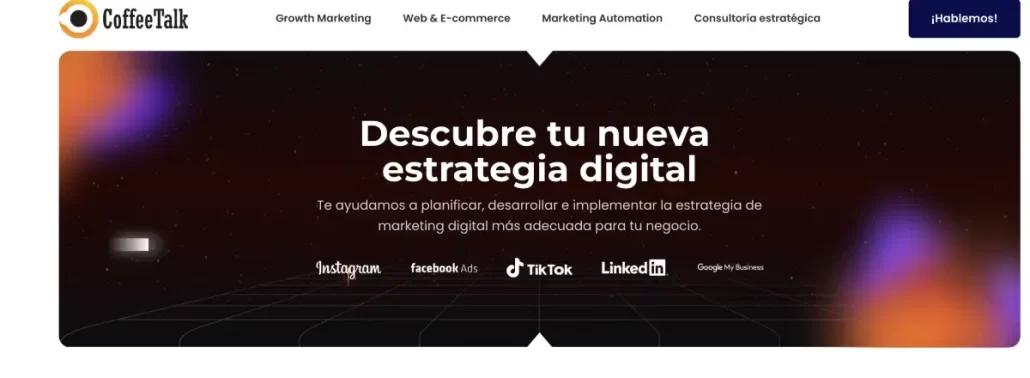
2. CoffeeTalk Digital Agency

digital marketing agency in Buenos Aires

CoffeeTalk: Full-service agency: design, development, digital campaigns (Google, Meta, TikTok) and consulting. They define themselves as partners of their clients, not an agency that “does something once.”

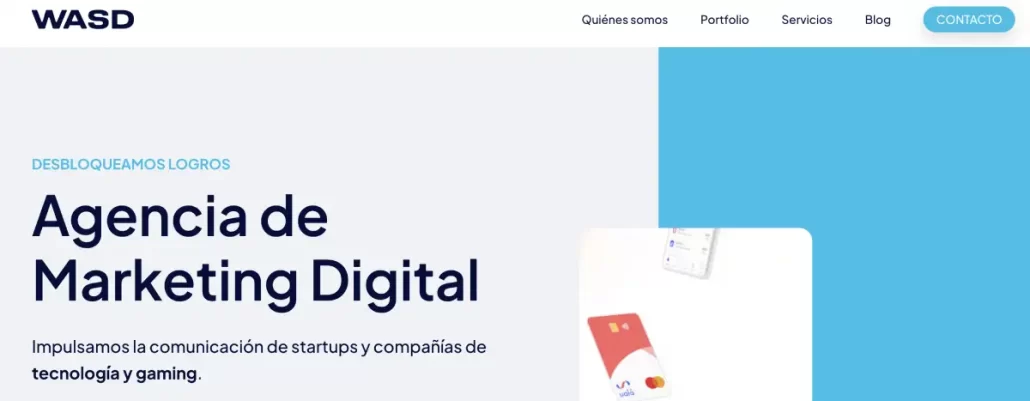
3. Wasd

wasd marketing digital

Wasd: Focused on digital marketing, content & communication for startups, technology and gaming companies. They work with creativity, strategy and digital campaigns.

4. Wunderman Thompson Argentina / VML Argentina

vml argentina agencia de marketing

Wunderman Thompson Argentina is a global agency with a strong presence in the Argentinian market. They specialize in creating unique brand experiences through the integration of data, creativity, and technology. Their services include content marketing, digital advertising, data analytics, and more. With a focus on innovation and excellence, they have worked with some of the world’s most recognized brands.

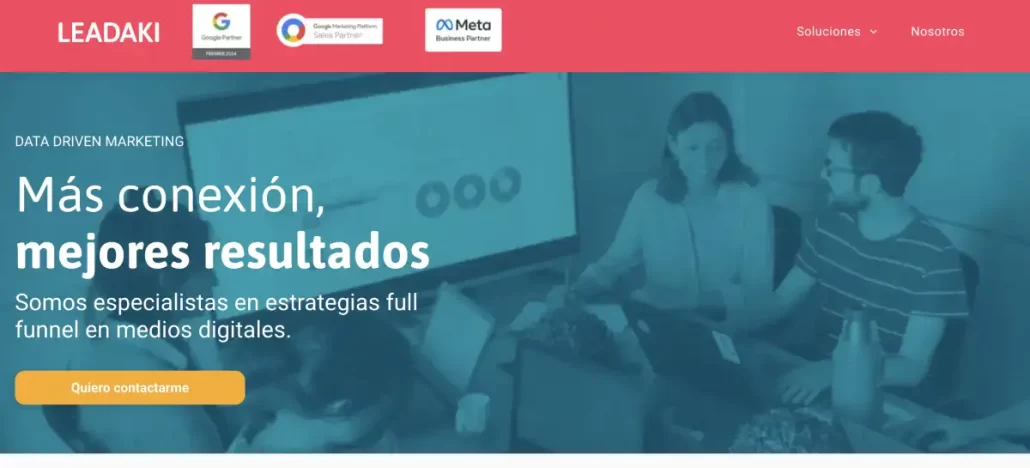
5. Leadaki

online advertising agency leadaki

Leadaki: An agency specializing in full-funnel and performance strategies, with a strong focus on data, automation, and cross-channel optimization. It is a Google Premier Partner.

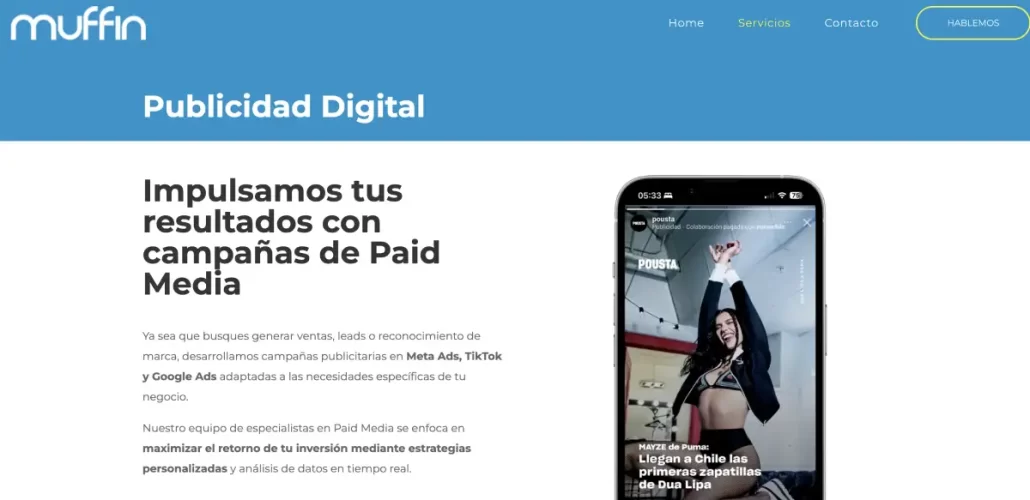
6. Muffin Agencia de Marketing Digital

muffin marketing online

Agency focused on social media, Google Ads and account management, with a presence in La Plata and clients in LATAM.

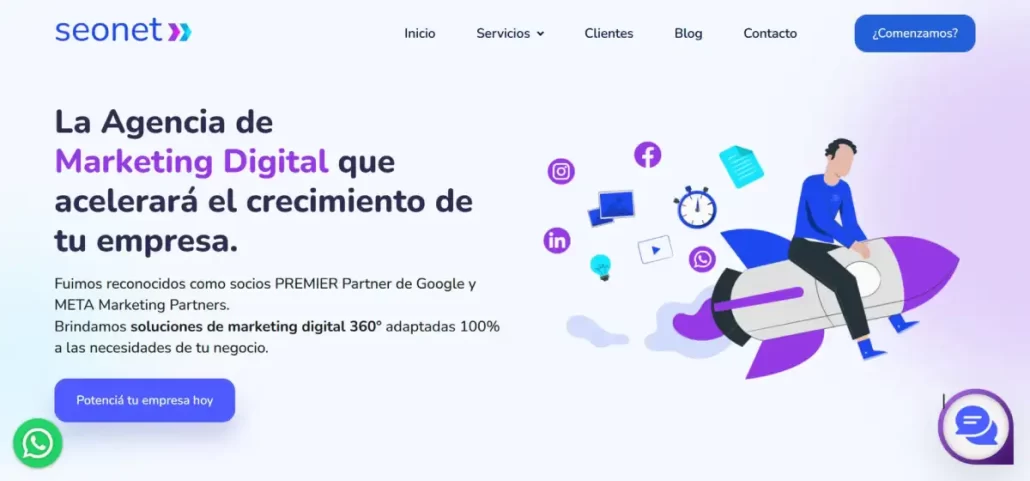
7. SEONET

agencia seonet

Seonet is a full-service digital marketing agency offering a wide range of services, from content creation to advertising campaign management. Their focus on personalization and attention to detail allows them to develop effective strategies that resonate with target audiences. They have worked with clients across various sectors, helping them increase their visibility and generate tangible results.

8. Bloop Agency

bloop agency

Marketing agency that blends performance + content + technology to scale e-commerce and B2B.

9. Imactions

imactions agency

Imactions is a digital agency that offers comprehensive services (social, paid, strategy) with an emphasis on measurable results.

10. MD Marketing Digital

md marketing digital

We have an incredible capacity for adaptation and, without exception, we develop unique proposals for each client. From startups to large corporations, we do tailor-made marketing.

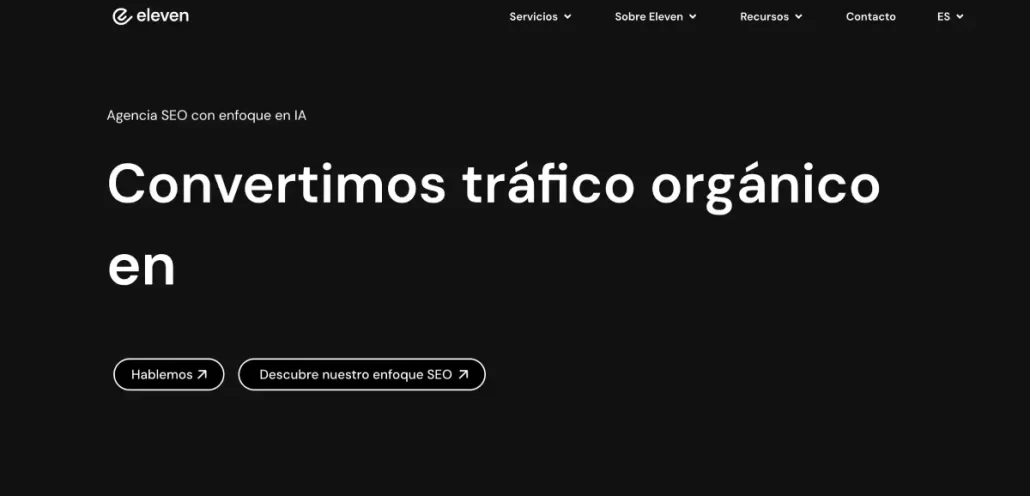
11. Agencia Eleven

marketing agency eleven

Eleven Agency stands out for its focus on performance marketing and campaign optimization. They offer SEO, SEM, social media advertising, and other services, with a focus on maximizing return on investment. Their team of experts works in partnership with clients to develop customized strategies that generate measurable and sustainable results.

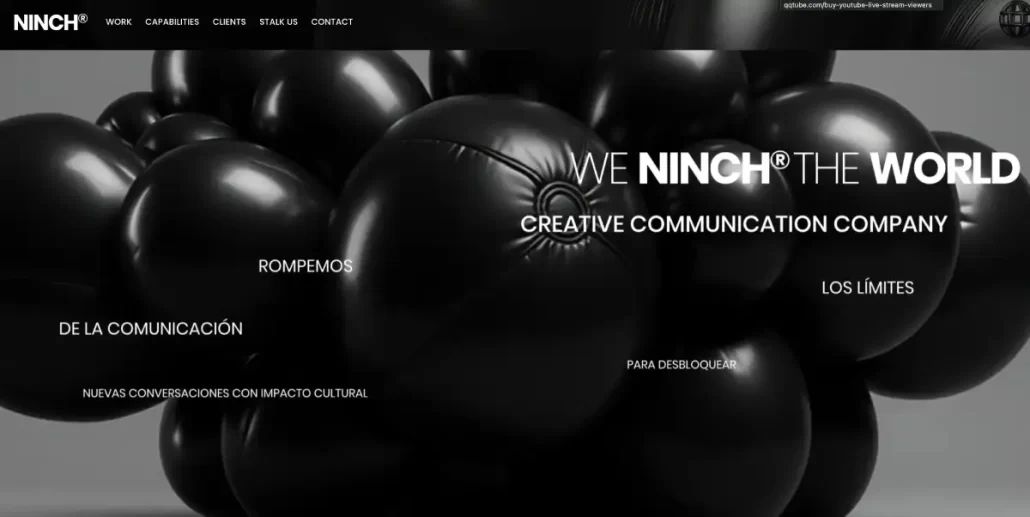
12. Agencia Ninch

agencia marketing ninch

Ninch Agency is a digital marketing agency specializing in content creation and social media management. Their focus on storytelling and high-quality content creation allows them to connect effectively with audiences. They offer SEO, content marketing, online advertising, and other services, with a focus on building long-lasting client relationships.

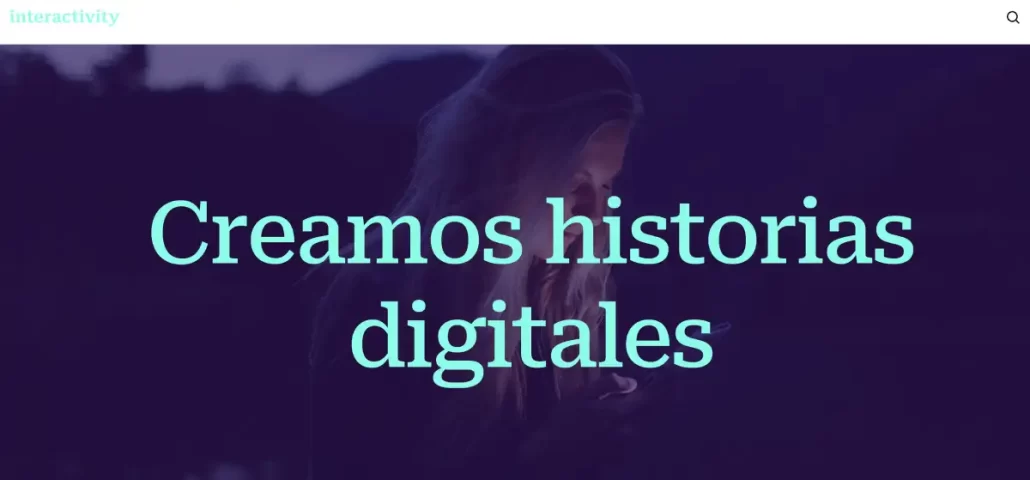
13. Agencia Interactivity

agencia interactivity

Interactivity Agency focuses on creating engaging digital experiences that deliver results. Their services include web design, social media marketing, SEO, and online advertising. With a team of professionals passionate about technology and creativity, they have helped numerous companies improve their online presence and achieve their marketing goals.

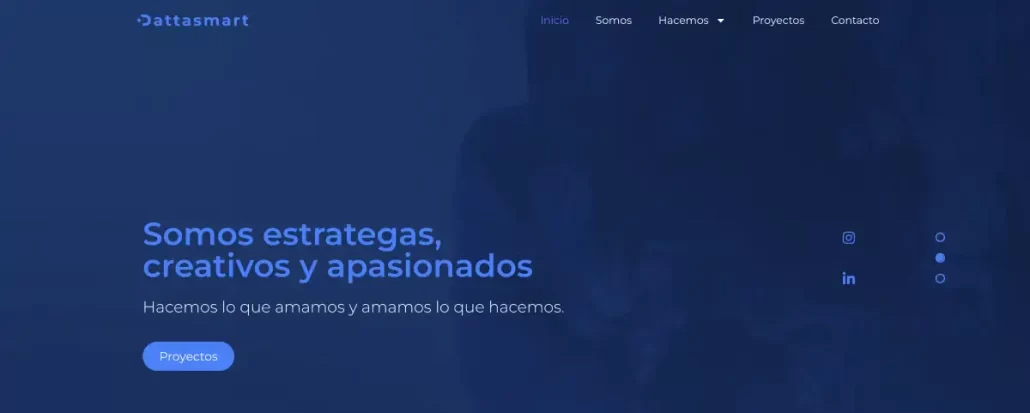
14. Agencia Dattasmart

maketing agency dattasmart

Communication and marketing agency with offices/operations in Argentina and Spain: branding, UX/UI, content and campaigns.

15. Agencia Buffalo

agencia buffalo

Our Buenos Aires-based team can respond to the diverse needs of our clients in marketing, online sales, social media management, corporate design, and web design and development. We offer solutions for businesses in Digital Design and SEO.

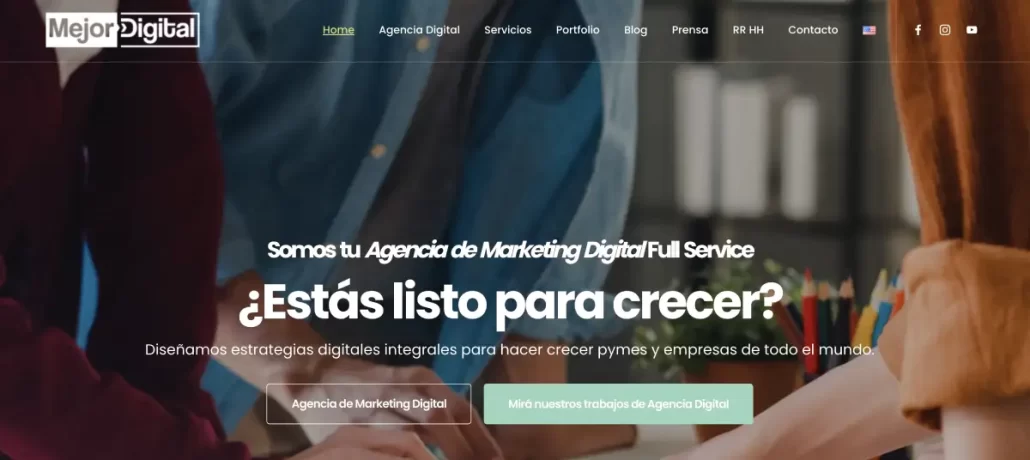
16. Mejor Digital

agencia mejor digital

As an innovative Digital Marketing agency, we develop comprehensive solutions that are attentive to the evolution of the Internet, Social Media, and the user experience with brands. We know the digital marketing tools you need to differentiate yourself, gain visibility, and position your products.

17. Agencia Zetenta

Zetenta interactive marketing agency

We are an interactive advertising agency specializing in online and mobile marketing, social media, digital branding and web development with offices in Buenos Aires, Argentina.

Our main strength is the ability to combine different talents to meet complex communication needs, blending creativity, design and technology to create authentic relationships between brands and consumers.

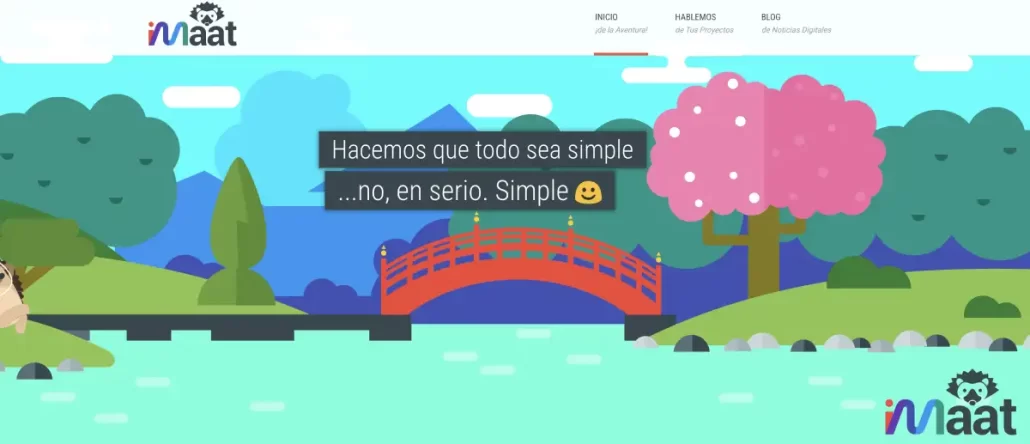
18. Agencia Imaat

imaat online marketing

We are a Digital Marketing Agency located in Buenos Aires, Argentina. We are a full-service agency. This means that we not only provide advertising services and advice but also cover all the necessary areas to transform and enhance your brand. We create a brand identity and give you a unique style to differentiate you from the rest. We develop your online presence: We create your company’s website and strengthen availability and communication with your potential clients through social media. We expand the reach of your sales channels with Google AdWords campaigns and build customer loyalty and attract new opportunities through organic email marketing. Finally, we produce videos and audiovisual content to take your company to the next level.

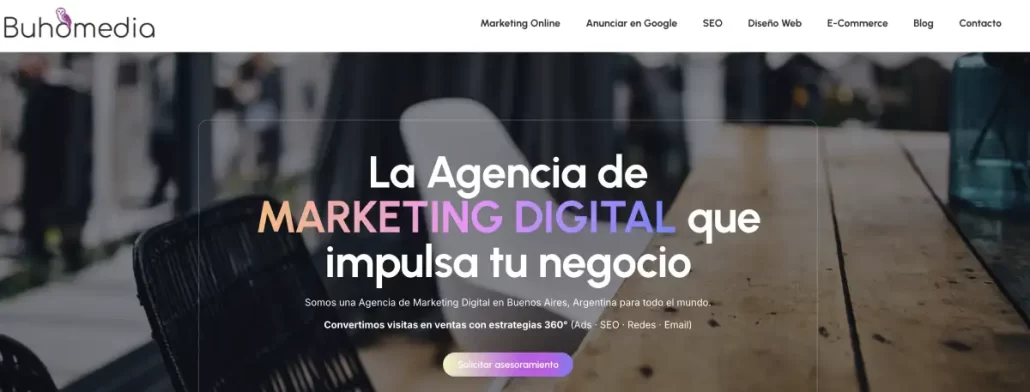
19. Agencia Buhomedia

agencia buhomedia

As a digital marketing company, we create unique digital experiences through our services: Digital Marketing, Google Ads, Web Design, E-commerce, Community Management, Hosting, Newsletters, and Corporate Videos

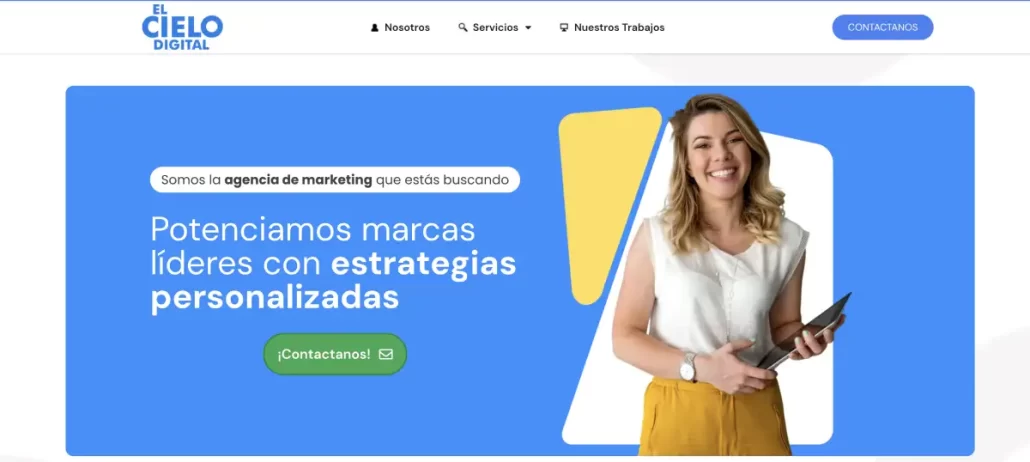
20. El Cielo Digital

el cielo digital

El Cielo Digital, with more than 10 years of experience, drives the growth of SMEs through digital strategies that increase their online presence and generate high-value leads.

Our experience allows us to help our clients plan, build, and execute everything related to their company’s digital marketing.

Services offered by featured agencies

The best digital marketing agencies in Argentina offer a wide range of services designed to improve businesses’ online presence and generate measurable results. One of the most common services is search engine optimization (SEO). SEO is crucial for improving a website’s visibility in organic search results, which can increase traffic and conversions. SEO agencies use a variety of techniques, such as keyword research, content optimization, and link building, to improve website rankings.

Another essential service is social media marketing. Agencies help businesses create and manage profiles on platforms like Facebook, Instagram, Twitter, and LinkedIn. This includes creating engaging content, managing communities, and running paid advertising campaigns. Social media is not only an effective platform for promoting products and services, but it also allows businesses to interact directly with their customers and build lasting relationships.

In addition, many agencies offer digital advertising services, including managing pay-per-click (PPC) campaigns on platforms like Google Ads and Bing Ads. Digital advertising allows businesses to efficiently reach a specific audience and measure campaign performance in real time. Other common services include content marketing, email marketing, web design and development, and data analytics. Each of these services can be customized to meet the specific needs of each business, ensuring an effective and well-executed digital marketing strategy.

Price comparison and service packages

The cost of digital marketing services can vary significantly depending on the agency and service package you choose. Some agencies offer basic packages that include essential services like SEO and social media management for a fixed monthly price. These packages can be a good option for small businesses or startups with limited budgets that still want to improve their online presence.

On the other hand, larger or more specialized agencies can offer customized packages that include a wider range of services, such as consulting, digital advertising, content marketing, and data analytics. These packages are typically more expensive, but they also offer a more comprehensive approach and a greater ability to adapt to the specific needs of each business. It’s important to carefully assess your company’s needs and compare the different packages and prices before making a decision.

Social Media Statistics in Argentina 2025

estadisticas de redes sociales en argentina 2025

We Are Social and Meltwater presented the updated report on social media statistics in Argentina Digital 2025. We will discuss the data recorded on the digital situation in Argentina in 2024-2025.

Use of mobile phones, Internet and social media networks

Social Media Statistics in Argentina 2025

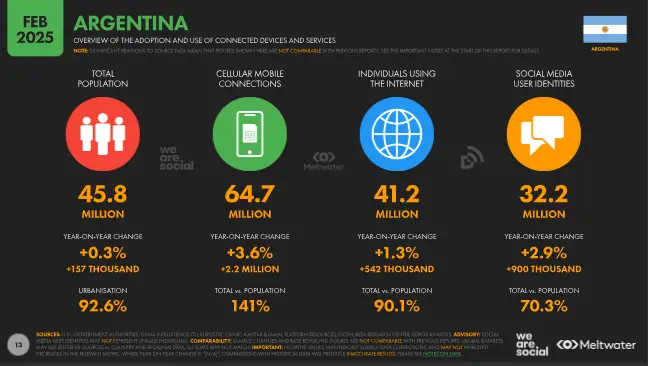
A total of 64.7 million mobile cellular connections were active in Argentina at the beginning of 2025, representing 141% of the total population. However, it should be noted that some of these connections may only include services such as voice and SMS, and some may not include internet access.

There were 41.2 million individuals using the internet in Argentina at the beginning of 2025, when online penetration was 90.1%.

Argentina was home to 32.2 million social media user identities in January 2025, which is equivalent to 70.3% of the total population.

General summary of Internet use in Argentina

Internet use in Argentina

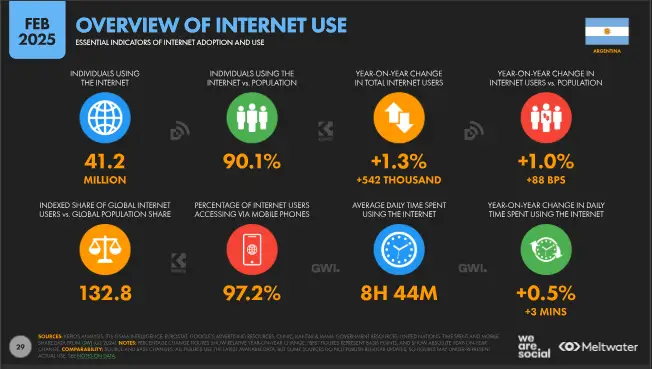
At the time of writing the report, the latest available data indicated that there were 41.2 million internet users in Argentina in January 2025.

This means that the internet penetration rate in Argentina stood at 90.1% of the total population at the beginning of the year.

Meanwhile, Kepios’ analysis indicates that the number of internet users in Argentina increased by 542,000 (+1.3%) between January 2024 and January 2025.

To add perspective, the Internet adoption rate in Argentina (i.e., the percentage of the total population using the Internet) increased by a relative 1% (+88 basis points) during the same period.

Use of social media in Argentina

Use of social media in Argentina

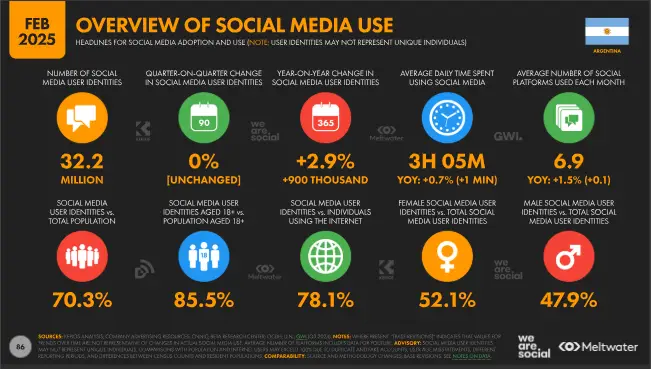
DataReportal figures show that in January 2025 there were 32.2 million active social media users in Argentina.

In perspective, this figure was equivalent to 70.3% of the total population of Argentina at the beginning of 2025.

Kepios’ analysis shows that social media user identities in Argentina increased by 900,000 (+2.9%) between early 2024 and early 2025.

Turning our attention back to user demographics, data published in the ad planning tools of major social media platforms indicates that there were 29.1 million users over the age of 18 using social media in Argentina at the beginning of 2025, which was equivalent to 85.5% of the total population aged 18 and over.

Most used Social Media Platforms in Argentina

Most used Social Media Platforms in Argentina

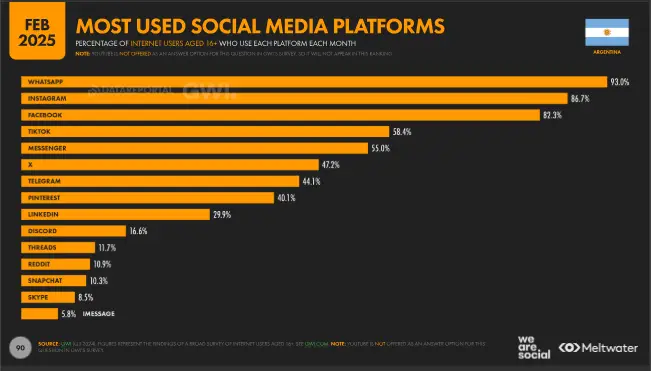
WhatsApp (93% of internet users) remains the most used platform in Argentina, among people aged 16 to 64.

TikTok continues to grow among the most used platforms, although it is still not close to the top 3. It ranks as the fourth most used platform (58.4%).

Facebook audience statistics

Facebook advertising in Argentina

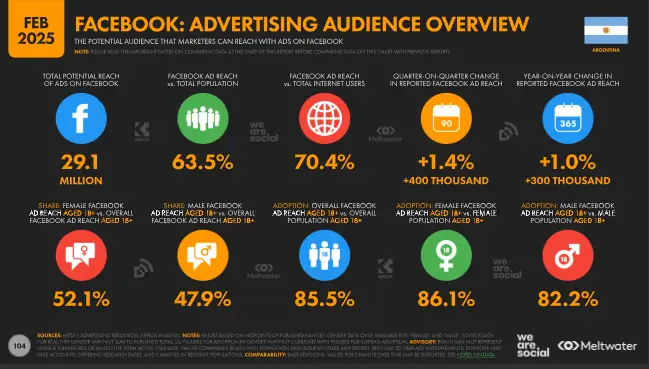
Data published in Meta’s advertising resources indicates that Facebook had 29.1 million users in Argentina at the beginning of 2025.

However, Meta has made significant changes to how its advertising resources report audience data in recent months – including making significant revisions to published audience data – so the figures shown here may not be directly comparable to those published in previous reports.

Figures published in Meta’s own tools indicate that the potential reach of Facebook ads in Argentina increased by 300,000 (+1%) between January 2024 and January 2025.

For a more recent context, the same data shows that the number of users that marketers could reach with Facebook ads in Argentina increased by 400,000 (+1.4%) in the three months between October 2024 and January 2025.

Instagram audience statistics

Instagram audience statistics in argentina

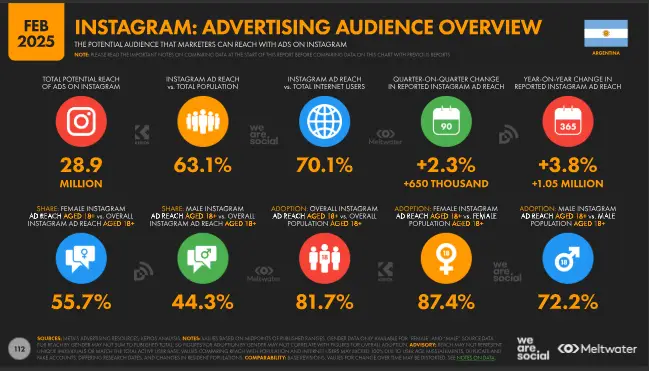
The numbers published in Meta’s advertising tools indicate that Instagram had 28.9 million users in Argentina at the beginning of 2025.

The company’s regularly reviewed figures suggest that Instagram’s ad reach in Argentina was equivalent to 63.1% of the total population at the beginning of the year.

However, Meta only allows people over the age of 13 to use Instagram, so it is also worth noting that 76.8% of the “eligible” audience in Argentina used Instagram at the time of the report’s production.

Data published in Meta’s planning tools shows that the potential reach of Instagram ads in Argentina increased by 1.05 million (+3.8%) between January 2024 and January 2025.

Quarterly, the company’s data also reveals that the size of Instagram’s ad audience in Argentina increased by 650,000 (+2.3%) between October 2024 and January 2025.

TikTok audience statistics

TikTok audience statistics in Argentina

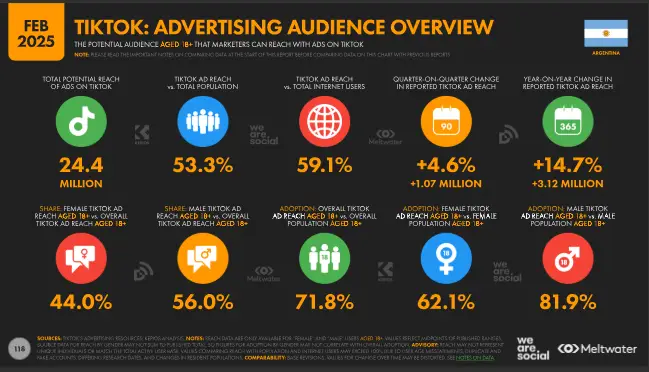
Figures published in TikTok’s advertising resources indicate that at the beginning of 2025 there were 24.4 million users over the age of 18 in Argentina.

TikTok allows marketers to target TikTok ads to users over the age of 13 through its advertising tools, but these tools only show audience data for users over the age of 18.

TikTok’s figures indicate that TikTok ads reached 71.8% of all adults over 18 years of age in Argentina by early 2025.

Data published in TikTok’s own advertising planning tools shows that TikTok’s potential advertising reach in Argentina increased by 3.12 million (+14.7%) between early 2024 and early 2025.

Meanwhile, the figures indicate that the potential reach of ads on TikTok in Argentina increased by 1.07 million (+4.6%) between October 2024 and January 2025.

LinkedIn audience statistics

LinkedIn audience statistics in Argentina

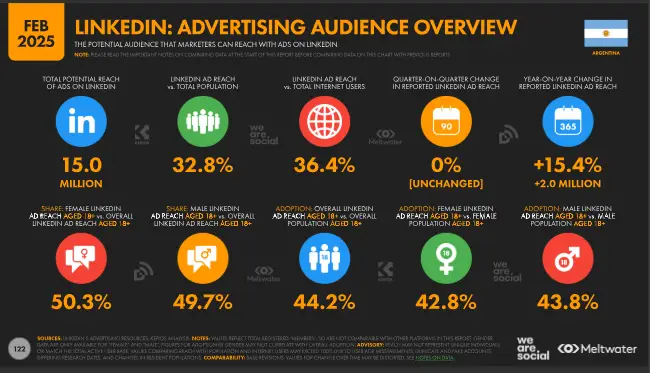
Data published in LinkedIn’s planning tools shows that the potential reach of LinkedIn ads in Argentina increased by 2 million (+15.4%) between the beginning of 2025 and the beginning of 2026.

Quarterly, the company’s data reveals that the audience size for LinkedIn ads in Argentina remained the same between October 2024 and January 2025.

Linkedin continue to be the most important B2B social media platform for every digital marketing agency specialized in corporate marketing

X (Twitter) audience statistics

X (Twitter) audience statistics in argentina

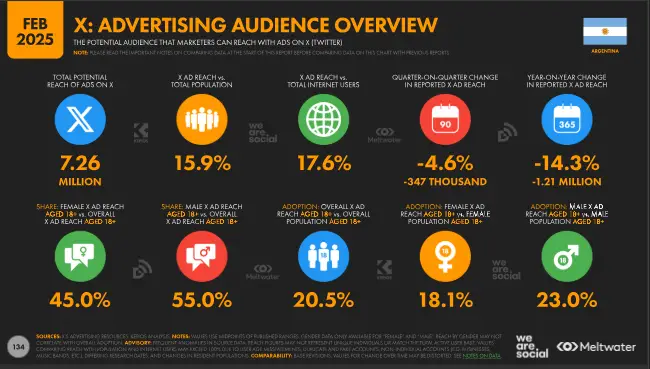
Data published in X’s own advertising planning tools shows that X’s potential advertising reach in Argentina decreased by 1.21 million (-14.3%) between early 2024 and early 2025.

Meanwhile, the same data shows that the number of users marketers could reach with ads on X in Argentina decreased by 347,000 (-4.6%) between October 2024 and January 2025.

However, it should be noted that the figures published in X’s planning tools are subject to significant fluctuations – even over short periods of time – and these anomalies can affect the reliability and representativeness of these change figures.

Digital Advertising Spending

Digital Advertising Spending in argentina
Digital Advertising in argentina

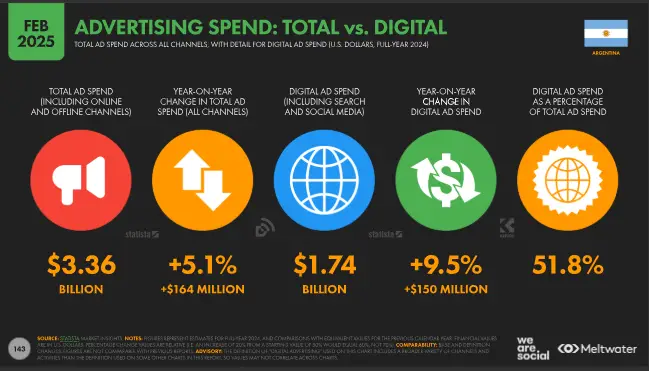
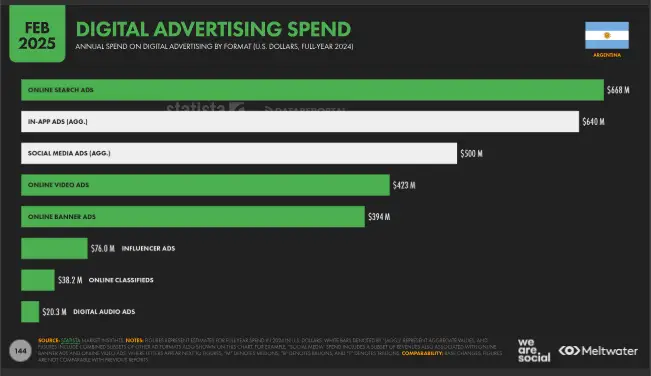
Spending on digital advertising increased by 9.5% in the last year. This equates to more than $150 million USD.

Of the total $1.74 trillion USD invested in digital advertising in 2024, the following is shown:

– $668 million USD was allocated to search engine campaigns.

– $423 million USD was spent on video advertising, while $394 million was spent on banner ads.

– $76 million USD was invested in influencer marketing.

– $38.2 million USD was spent on classified ads.

Source: Digital.

These statistics clearly demonstrate the importance of continuing to rely on a digital strategy agency for the development of any company in today’s world.

Read more Digital Marketing news.

Social Media Statistics Peru 2025

Estadísticas de Redes Sociales Perú 2025

We Are Social and Meltwater presented the updated report Digital 2025 on Social Media Statistics in Peru. We will discuss the data recorded on the digital situation in Peru in 2024-2025.

Use of Devices, Internet and Social Networks

Use of Devices, Internet and Social Networks in Peru

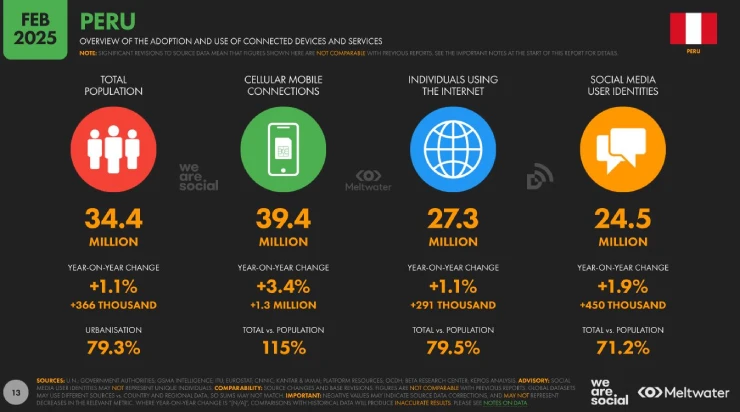
A total of 39.4 million mobile cellular connections were active in Peru at the beginning of 2025, equivalent to 115% of the total population. However, some of these connections may only include services such as voice and SMS, and some may not include internet access.

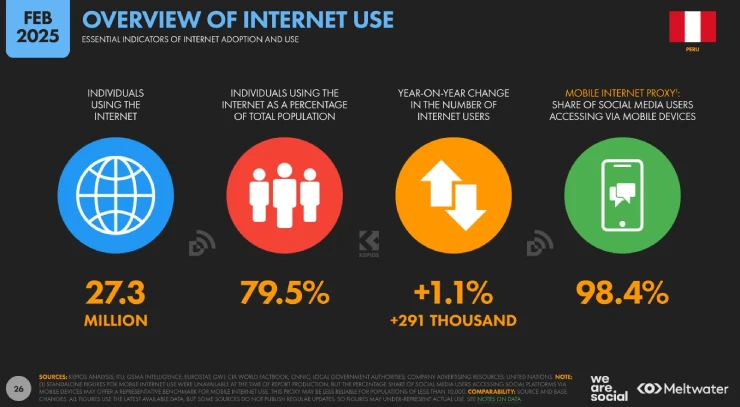
27.3 million people used the internet in Peru at the beginning of 2025, when online penetration was 79.5%.

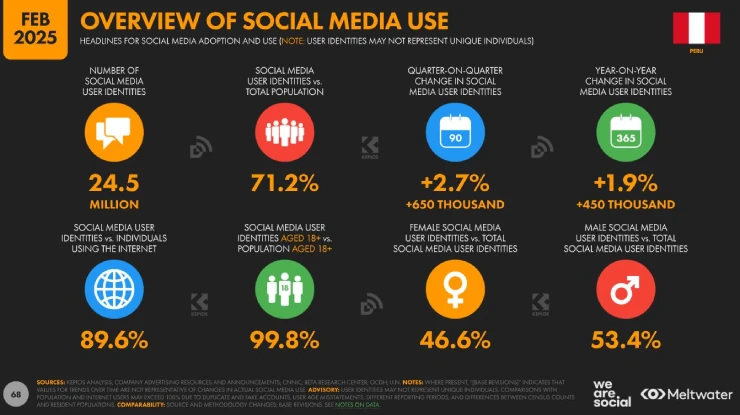
In January 2025, Peru had 24.5 million social media users, which is equivalent to 71.2% of the total population.

These main statistics offer a great overview of the “digital state” in Peru at the beginning of 2025, but to understand how digital trends and behaviors have evolved over time, we need to delve deeper into the data.

General Summary of Internet Use

Social Media Statistics Peru 2025

At the time of writing the report, the latest available data indicated that there were 27.3 million internet users in Peru in January 2025.

This means that the internet penetration rate in Peru was 79.5% of the total population at the beginning of the year.

Meanwhile, Kepios’ analysis indicates that the number of internet users in Peru increased by 291,000 (+1.1%) between January 2024 and January 2025.

Social Media Statistics Peru – General Summary of Social Media Use

Social Media Statistics Peru - General Summary of Social Media Use

DataReportal figures show that in January 2025 there were 24.5 million active social media users in Peru.

In perspective, this figure was equivalent to 71.2% of the total population at the beginning of 2025.

The analysis by Kepios shows that the identities of social media users in Peru increased by 450,000 (+1.9%) between the beginning of 2024 and the beginning of 2025.

Data published in the ad planning tools of major social media platforms indicates that there were 24.5 million users over the age of 18 using social media in Peru at the beginning of 2025, which was equivalent to 99.8% of the total population aged 18 and over.

At that time, 46.6 percent of social media user identities in Peru were female, while 53.4 percent were male.

And to add context, it may be helpful to know that 89.6% of Peru’s total internet user base (regardless of age) used at least one social media platform in January 2025.

Social Media Statistics Peru 2025 – YouTube Audience

YouTube Audience Social Media Statistics Peru 2025

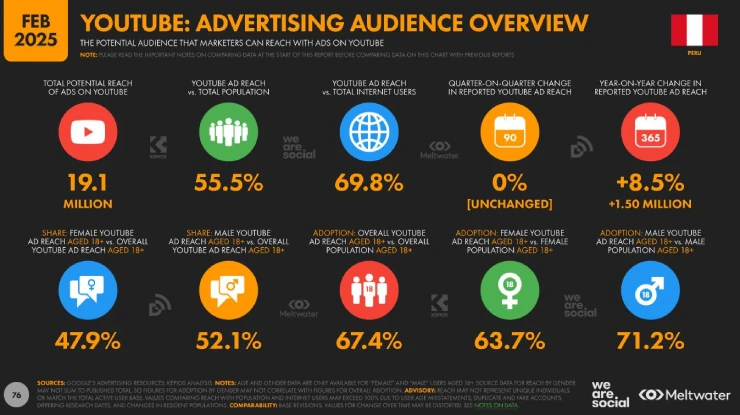
Google’s advertising resources indicate that YouTube had 19.1 million users in Peru at the beginning of 2025.

The company’s own data suggests that the reach of the YouTube ad in early 2025 was equivalent to 55.5 percent of the total population of Peru at the beginning of the year.

To put these figures into perspective, YouTube ads reached 69.8% of Peru’s total internet user base (regardless of age) in January 2025.

At that time, 47.9% of YouTube’s adult ad audience in Peru was female, while 52.1% was male.

Data published in Google’s own advertising planning tools shows that the potential reach of YouTube ads in Peru increased by 1.5 million (+8.5%) between early 2024 and early 2025.

Social Media Statistics Peru 2025 – Facebook Audience

Facebook Audience

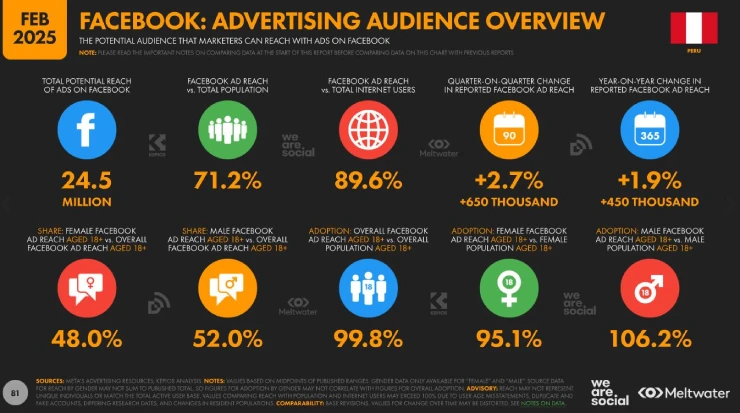
Figures published in Meta’s own tools indicate that the potential reach of Facebook ads in Peru increased by 450,000 (+1.9 percent) between January 2024 and January 2025.

In a more recent context, the same data shows that the number of users that marketers could reach with Facebook ads in Peru increased by 650,000 (+2.7%) in the three months between October 2024 and January 2025.

Facebook ads reached 71.2 percent of the total population in Peru at the beginning of 2025. This reach was equivalent to 89.6% of the local internet user base (regardless of age) in January 2025.

Social Media Statistics Peru 2025 – Instagarm Audience

Instagram Audience

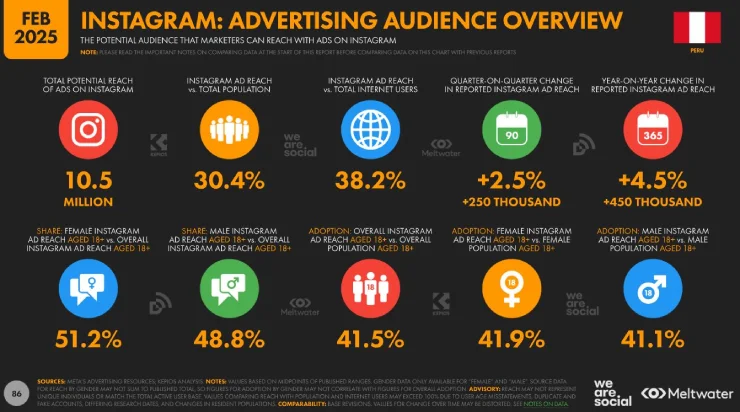
The numbers published in Meta’s advertising tools indicate that Instagram had 10.5 million users in Peru at the beginning of 2025.

The company’s regularly revised figures suggest that Instagram’s ad reach in Peru was equivalent to 30.4% of the total population at the beginning of the year.

Data published in Meta’s planning tools shows that the potential reach of Instagram ads in Peru increased by 450,000 (+4.5%) between January 2024 and January 2025.

Quarterly, the company’s data also reveals that the size of Instagram’s ad audience in Peru increased by 250,000 (+2.5%) between October 2024 and January 2025.

Social Media Statistics Peru 2025 – TikTok Audience

TikTok Audience

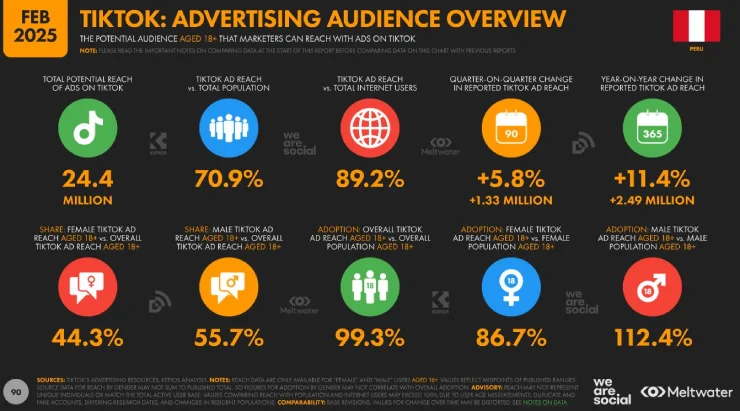
Data published in TikTok’s own advertising planning tools shows that TikTok’s potential advertising reach in Peru increased by 2.49 million (+11.4 percent) between early 2024 and early 2025.

Meanwhile, the figures indicate that the potential reach of ads on TikTok in Peru increased by 1.33 million (+5.8 percent) between October 2024 and January 2025.

Social Media Statistics Peru 2025 – Linkedin Audience

Linkedin Audience

LinkedIn continues to grow and consolidate its position as the most important B2B social media platform for the region.

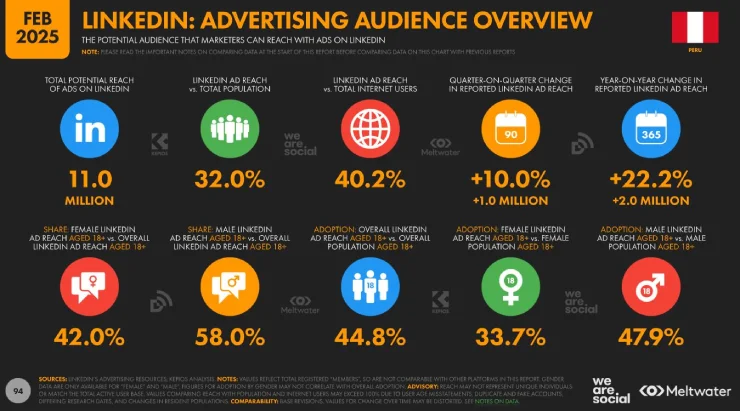
Data published in LinkedIn’s planning tools shows that the potential reach of LinkedIn ads in Peru increased by 2.0 million (+22.2%) between the beginning of 2024 and the beginning of 2025.

Quarterly, the company’s data reveals that the size of LinkedIn’s ad audience in Peru increased by 1 million (+10%) between October 2024 and January 2025.

It’s important to note that LinkedIn’s advertising tools publish audience reach data based on the total number of registered members, rather than the monthly active users that form the basis of ad reach figures published by most other social media platforms.

As a leading digital marketing agency in Latin America, we work with various companies in the planning and development of their digital strategies in the region. Whether they are B2B, B2C, small or large companies, we know how to use internet resources to boost their businesses.

Read more Digital Marketing News.

Social Media Statistics Uruguay 2023

Estadísticas de redes sociales en Uruguay 2023

We Are Social y Meltwater presentaron la actualización del Digital 2023 Global Overview Report. Hablaremos de los datos registrados sobre la situación digital en Uruguay en el 2022-2023.

Uso de móviles, Internet y redes sociales

Estadísticas de redes sociales en Uruguay 2023

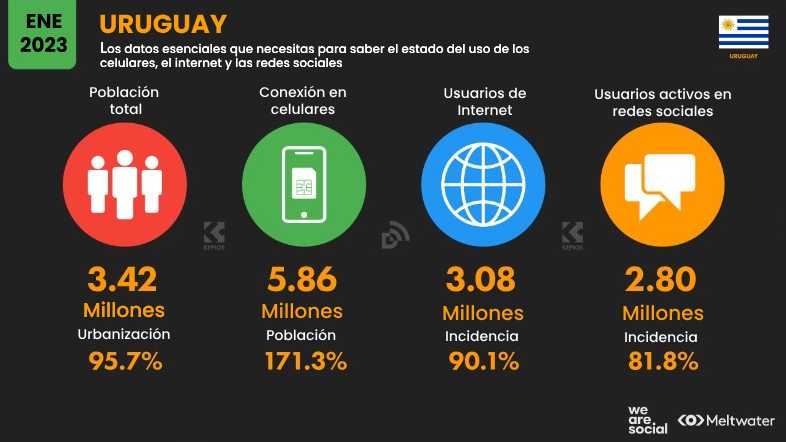
La población uruguaya está conformada por 3.42 millones de personas, de las cuales el 95.7% viven en zonas urbanizadas.

El número de dispositivos móviles conectados en el país es de 5.86 millones, lo que supone que hay más de un aparato celular por persona en promedio.
Los usuarios de Internet activos en el país representan el 90.1% de la población total. De ese 90.1%, 81.8% es activo en diversas redes sociales, entre ellas: Facebook, Tik Tok, Instagram, YouTube.
Crecimiento digital: enero 2022 vs enero 2023

Estadísticas de redes sociales en Uruguay 2023

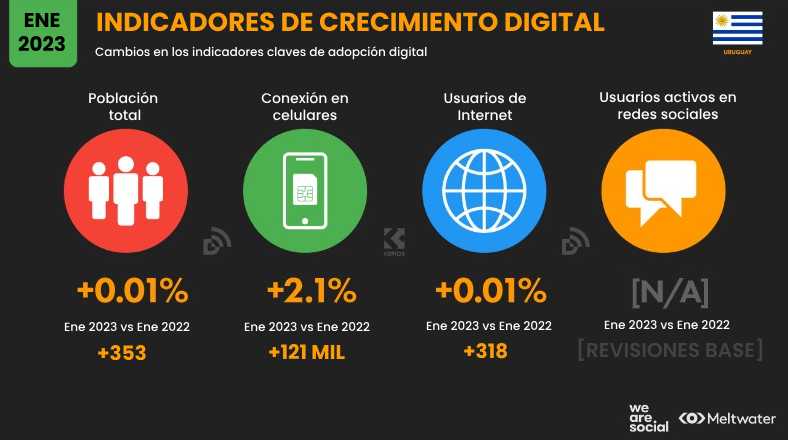
Con respecto al 2022, la población en Uruguay aumentó en un 0.01%.

Desde el año pasado las conexiones telefónicas móviles aumentaron, específicamente en un 2.1%.

El porcentaje de usuarios de Internet aumentó en un 0.01%, a lo largo de un año.

El número de usuarios conectados a redes sociales no se ha registrado aún.

Resumen general del uso de Internet en Uruguay

Estadísticas de redes sociales en Uruguay 2023

¿Cuánto tiempo crees que pasas frente a la pantalla de tu teléfono?

El uso de los dispositivos móviles se ha vuelto esencial.

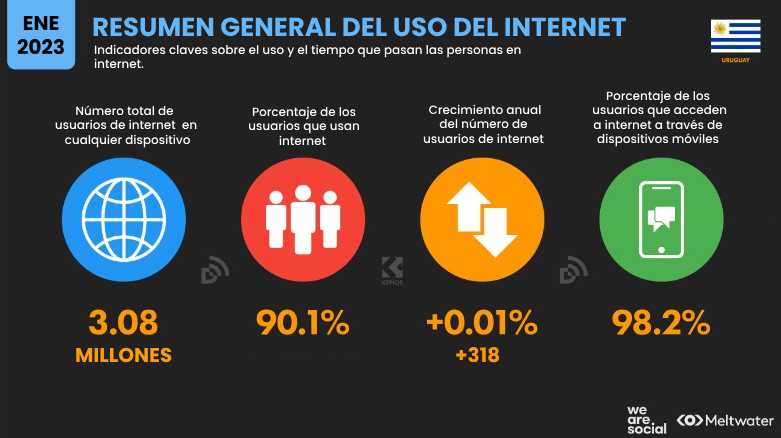
3.08 millones de usuarios son los que acceden a Internet desde cualquier dispositivo, registrando un aumento del del 0.01% anual.

De la totalidad de estos usuarios, el 98.2% acceden a internet través de dispositivos móviles.

Uso de redes sociales

Estadísticas de redes sociales en Uruguay 2023

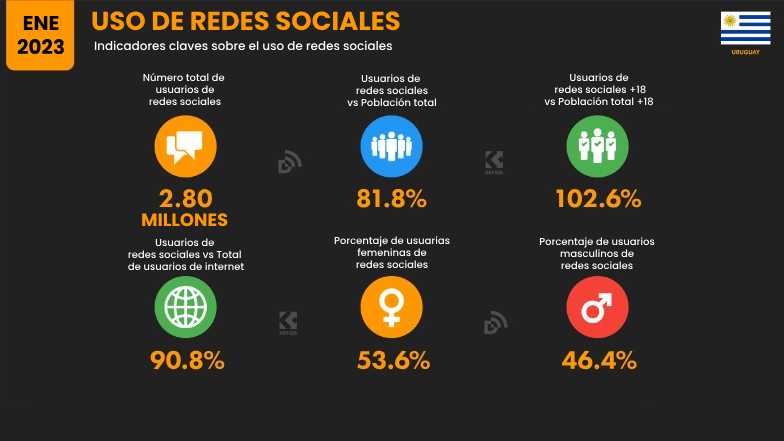
2.80 millones de personas usan redes sociales activamente en Uruguay, es decir, el 81.8% de la población total.

El 53.6% de usuarios de redes sociales son mujeres, mientras que el 46.4% son hombres.

Estadísticas de la audiencia de Facebook

Estadísticas de redes sociales en Uruguay 2023

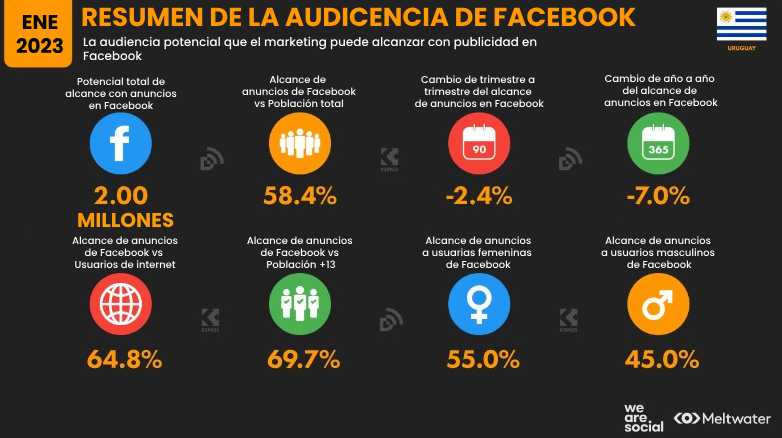
¿Sabías que por medio de los anuncios publicitarios dentro de Facebook, se alcanzan potencialmente a 2 millones de personas en Uruguay? Esto presenta el 69.7% de la población activa en redes sociales mayor de 13 años. Una gran forma de comenzar a implementarlos es mediante una agencia de marketing digital argentina.

Dicho público alcanzado, se conforma por un 55% de mujeres y 45% de hombres.

Estadísticas de la audiencia de Instagram

Estadísticas de redes sociales en Uruguay 2023

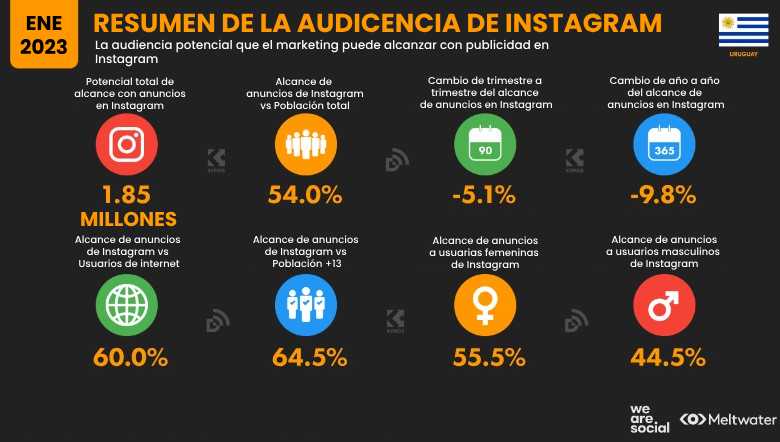
A través de los anuncios publicitarios en de Instagram, se alcanzan potencialmente a 1.85 millones de uruguayos.

Esto representa el 64.5% de la población activa en redes sociales mayor de 13 años.

El público alcanzado está conformado por un 55.5% de mujeres y 44.5% de hombres.

A pesar de que Instagram es una red social muy popular, apenas un 54% de los uruguayos la usan.

Estadísticas de la audiencia de Twitter

Estadísticas de redes sociales en Uruguay 2023

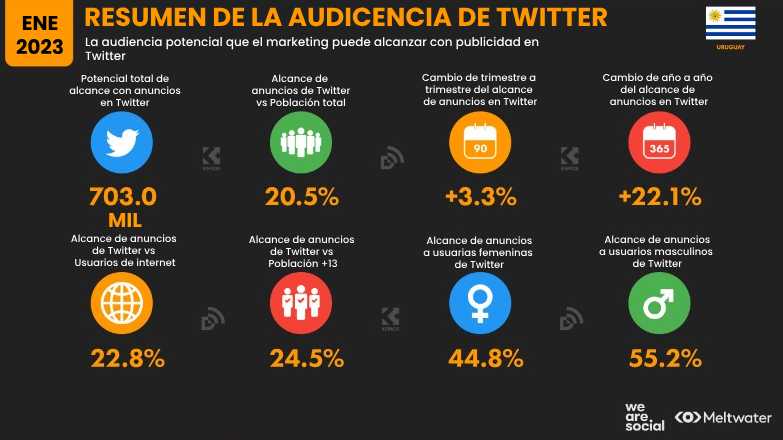
Los anuncios publicitarios de Twitter alcanzan potencialmente a 703 mil de personas.
El 24.5% son mayor de 13 años, de los cuales hay un aumento del 3.3% en el cambio trimestral.
El público se divide en un 44.8% mujeres y 55.2%  hombres.

Estadísticas de la audiencia de LinkedIn

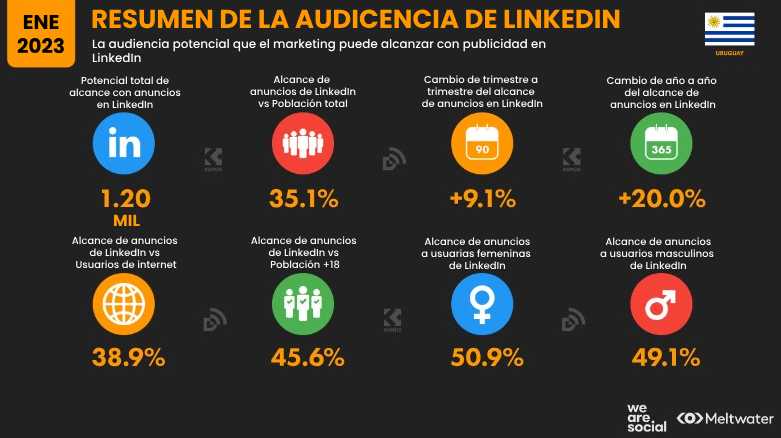
1.20 millones de personas son alcanzadas a través de sus anuncios publicitarios en LinkedIn.

Esto presenta el 45.6% de la población activa en redes sociales mayor de 18 años.

Se presentó un aumento trimestral del 9.1%.

En la segmentación de usuarios por género, LinkedIn se conforma por el 50.9% de mujeres, y el 49.1% de hombres.

ver más noticias de marketing digital

Way2net awarded as Top Digital Marketing Agency in Argentina

Way2net awarded as Top Digital Marketing Agency in Argentina

Way2net is a digital marketing agency, specialized in e-strategy planning and business development, digital marketing, online advertising, web optimization, social media, web design, and development. We are a Google Partner Agency certified by Google Inc. and we offer a wide variety of services including digital strategy, social media marketing, and advertising.

Clutch recently announced the top digital marketing agencies in Argentina. We are excited to announce that Way2net has made the list on their directory.

Way2net awarded as Top Digital Marketing Agency in Argentina

Clutch is a B2B market research firm located in Washington DC that connects service providers and buyers through data and verified research. Central to their process is client reviews. In this unique process, analysts have spoken directly with many of our clients and learned more about the services we provided, as well as technological capabilities, results, and business acumen.

Our clients’ participation made this award possible, and we want to thank them for their time and honest feedback. Below is are excerpts from recent reviews, along with project summaries:

“We continue working with them because of their thoughtful service.” –Marketing Coordinator, Synthon Bagó

Our team was hired to develop a pharmaceutical company’s marketing strategies. We work with different social media channels, crafting campaigns. We also worked on their site.

“With Way2net Digital Marketing Agency, we found a mix of business expertise and digital experience.” –Founder, Delbazar

We provided a variety of digital services for an online store. Our team developed an e-commerce website and social media campaigns

Digital marketing has forever changed how companies attract customers and generate revenue. If you’re considering hiring an online marketing company to help you boost your brand image, position your company in search rankings, or manage your social media presence, The Manifest can help find a business to best suit your needs. The Manifest, an affiliate site of Clutch, lists top digital marketing companies in Argentina. Among top companies, the site also lists descriptions, projects, and awards for users to utilize.

Need advice in marketing and communication? We are experts in digital strategy. Contact us by phone or fill out the form on our website and a team member will be in touch shortly. We look forward to hearing from you and your team.

Social Media Image Sizes: Complete Guide for 2026

tamaño de imagenes de redes sociales

Images and videos are playing an increasingly important role in social media content. Therefore, it is essential to understand the recommended image sizes for each social media platform, since visual content is often the first interaction users have with a brand.

One important factor to keep in mind is that image dimensions can vary depending on whether the content is viewed on mobile devices or desktop computers.

Social Media Image Sizes in 2026: Updated Guide by Platform

Publishing images in the correct size is not just an aesthetic consideration. It can directly affect organic reach, engagement rates, and advertising performance.

Each platform compresses, crops, and displays images differently. Therefore, using the recommended dimensions helps prevent quality loss, unexpected cropping, and reduced visibility in users’ feeds.

In this updated 2026 guide, you’ll find the recommended image sizes for Instagram, Facebook, LinkedIn, X (Twitter), YouTube, TikTok, and Pinterest, along with key technical recommendations to improve your results.

What Should You Consider Before Choosing an Image Size?

Beyond the number of pixels, it is important to consider:

  • Aspect ratio
  • Safe area, especially for advertising content
  • Minimum recommended resolution, with 1080 px wide as a general standard
  • File size and automatic compression applied by each platform

The most important aspect ratios in 2026 are:

  • 1:1 — Square
  • 4:5 — Vertical, optimized for feed content
  • 9:16 — Stories, Reels, and vertical video
  • 16:9 — Horizontal video and YouTube

Facebook Image Sizes

Social Media Image Sizes for facebook

Facebook remains one of the most widely used social media platforms for both businesses and individuals. Choosing the correct dimensions helps ensure that your visual content is displayed properly across devices.

  • Profile photo: 320 × 320 pixels. This size applies to both personal profiles and business pages.
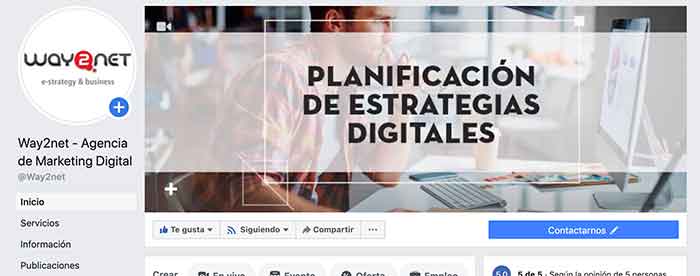
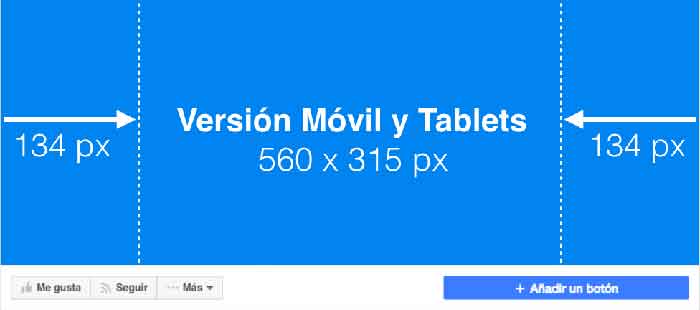
  • Facebook cover image: 851 × 315 pixels for desktop and 560 × 315 pixels for mobile.
  • Facebook cover video: 820 × 312 pixels. Recommended format: MP4. Video duration should be between 20 and 90 seconds.
  • Square posts: 1200 × 1200 pixels.
  • Landscape posts: 1200 × 900 pixels.
  • Link post images: 1200 × 628 pixels.
  • Facebook ads: 1600 × 628 pixels.

When designing Facebook cover images, keep in mind that content placed near the sides may be cropped on mobile devices. Important text and visual elements should therefore be positioned within the safe area.

facebook coverage Social Media Image Sizes

Facebook Ad Image Sizes

For Facebook advertising, it is recommended to use the same dimensions as square posts —1200 × 1200 pixels— or at least 1080 × 1080 pixels.

The platform will automatically resize the creative depending on the placement.

Examples include:

Right-column ad: 254 × 133 pixels.erales es recortada como se ve en la siguiente imagen

Desktop ad image: 470 × 246 pixels.

Mobile ad image: 560 × 292 pixels.

Instagram Image Sizes

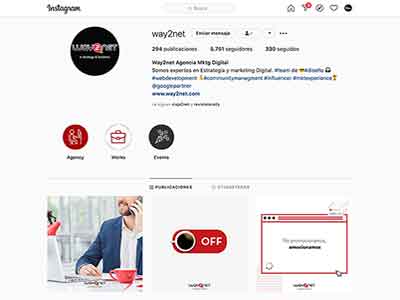
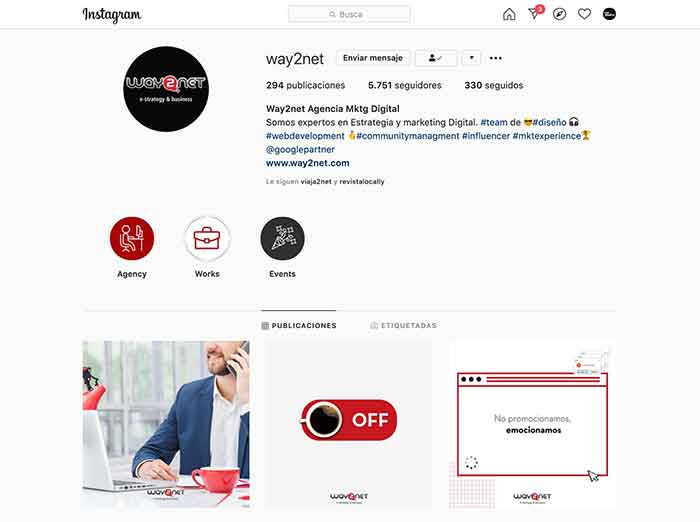
Social Media Image Sizes for instagram

Instagram is one of the most visual social media platforms, making image quality and format particularly important for brands.

  • Profile image: 320 × 320 pixels. Minimum resolution: 180 × 180 pixels.
  • Square post: 1080 × 1080 pixels.
  • Landscape image: 1080 × 566 pixels.
  • Portrait image: 1080 × 1350 pixels.
  • Instagram Stories: 1080 × 1920 pixels.

Video Sizes for Instagram

Whether you’re publishing videos in the feed or sharing them through Stories, using the correct dimensions helps ensure that the content is displayed properly.

  • Feed videos: 640 × 640 pixels, with a duration of between 3 and 60 seconds.
  • Instagram Stories videos: 750 × 1334 pixels, with a maximum duration of 10 seconds.

Instagram Ad Image Sizes

Instagram ad dimensions vary depending on the ad format and placement.

The main formats include:

  • Square ads: 1080 × 1080 pixels.
  • Landscape ads: 1080 × 566 pixels.
  • Story ads: 1080 × 1920 pixels, with a 9:16 aspect ratio. The minimum recommended size is 600 × 1067 pixels, with a maximum file size of 30 MB.

For the latest specifications, always check Instagram and Meta’s official advertising guidelines before launching a campaign.

IGTV Sizes

Videos can be published in both vertical and horizontal formats.

  • Vertical: maximum 9:16 and minimum 4:5.
  • Horizontal: maximum 16:9 and minimum 5:4.
  • Cover image: 1:1.55 ratio or approximately 420 × 654 pixels.

LinkedIn Image Sizes

Linkedin Social Media Image Sizes

LinkedIn is particularly relevant for professional networking and B2B communication. Visual content can play an important role in increasing engagement and strengthening a company’s professional presence.

Recommended dimensions include:

  • Personal profile photo: 400 × 400 pixels.
  • Personal profile cover image: 1584 × 396 pixels. Maximum file size: 4 MB.
  • Company cover image: 1584 × 396 pixels.
  • Company logo: 300 × 300 pixels.
  • Post image: 520 × 320 pixels.
  • Post with a link: 520 × 272 pixels.
  • Square post: 1080 × 1080 pixels.

LinkedIn Ads

LinkedIn also has specific recommended dimensions for different advertising formats.

Some of the main formats include:

  • General ads: 50 × 50 pixels.
  • Rectangle ads: 300 × 250 pixels.
  • Wide skyscraper: 160 × 600 pixels.
  • Leaderboard: 728 × 90 pixels.

LinkedIn Video Ads

Recommended specifications include:

  • File size: between 75 KB and 200 MB.
  • Format: MP4.

Available video dimensions include:

Horizontal:

  • 480 × 360 pixels
  • 640 × 360 pixels
  • 640 × 480 pixels
  • 960 × 720 pixels
  • 1280 × 720 pixels
  • 1440 × 1080 pixels
  • 1920 × 1080 pixels

Square:

  • Minimum: 600 × 600 pixels.
  • Maximum: 1080 × 1080 pixels.

Vertical:

  • Minimum: 500 × 625 pixels.
  • Maximum: 1080 × 1920 pixels.

X (Twitter) Image Sizes

Image Sizes for twitter

These are the recommended image dimensions for X, formerly known as Twitter:

  • Profile photo: 400 × 400 pixels.
  • Header image: 1500 × 500 pixels.
  • Post image: 1024 × 512 pixels.
  • Twitter/X Cards: 800 × 320 pixels.
  • Summary Card with image: 280 × 150 pixels.
  • In-stream image: minimum 440 × 220 pixels.

JPG, PNG, and GIF formats are supported for many types of visual content.

Pinterest Image Sizes in 2026

Image Sizes for pinterest

Pinterest is a highly visual platform where vertical images generally perform particularly well.

  • Profile image: 165 × 165 pixels.
  • Standard Pin: 1000 x 1500 px, with a 2:3 aspect ratio.
  • Board cover image: approximately 200 × 200 pixels.
  • Board cover thumbnail: 100 × 100 pixels.

Idea Pin / formato vertical

  • 1080 x 1920 px

Pinterest Ad Sizes

Promoted Pins should generally use:

  • 600 × 900 pixels
  • Recommended aspect ratio: between 2:3 and 1:3.5.

YouTube Image Sizes

Image Sizes for youtube

YouTube requires different image dimensions depending on the type of visual asset:

  • Profile image: 800 × 800 pixels.
  • Channel cover image: 2560 × 1440 pixels. Maximum file size: 6 MB.
  • YouTube thumbnail: 1280 × 720 pixels.

Thumbnails are particularly important because they can directly influence click-through rates and video views.

TikTok Image Sizes in 2026

TikTok is primarily designed around vertical content.

Profile Photo

  • 200 × 200 pixels

Vertical Videos and Images

  • 1080 × 1920 pixels
  • 9:16 aspect ratio

This format is ideal for TikTok videos and other full-screen vertical content.

Why Is It Important to Use the Correct Image Size?

Using the correct dimensions is not simply a matter of making your social media profiles look professional.

It can also contribute to better digital marketing performance by:

  • Improving CTR (click-through rate)
  • Increasing engagement
  • Reducing automatic cropping
  • Optimizing advertising campaigns
  • Strengthening the professional perception of your brand

Poor image resolution can even affect the performance of paid campaigns on platforms such as Meta Ads, LinkedIn Ads, and TikTok Ads.

For this reason, visual content should be considered an important part of your overall social media and digital marketing strategy.

Social Media Image Size Summary Table 2026

PlatformProfileFeed PostStories / ReelsCover
Instagram320 × 3201080 × 1080 / 1080 × 13501080 × 1920
Facebook320 × 3201200 × 1200 / 1200 × 6301080 × 1920820 × 312
LinkedIn400 × 4001200 × 6271584 × 396
X400 × 4001200 × 6751500 × 500
YouTube800 × 8001280 × 720 (thumbnail)2560 × 1440
TikTok200 × 2001080 × 19201080 × 1920
Pinterest165 × 1651000 × 15001080 × 1920

Final Recommendation

Social media image specifications are constantly evolving. Platforms update their formats, placements, and technical requirements regularly, so it is a good practice to review the recommended dimensions before creating a new campaign or content plan.

However, dimensions alone do not guarantee better results.

The quality of the creative, the message, the audience, the platform, and the overall digital marketing strategy are equally important. The right format simply ensures that your content has the best possible technical foundation.

If your company needs help developing a social media strategy, creating content, or managing digital campaigns, a specialized digital marketing agency can help you define the right formats and content strategy for each platform.

Smart Watches: New opportunities for personalized marketing

Relógios inteligentes

relojes inteligentes

The emergence of mobile and other devices has changed the way we live and what we expect from brands. We intend to constantly receive information and, in order to facilitate the measurements of athletes performance, smart watches and bracelets appeared and carry different sensors: accelerometer, GPS, compass and even the ability to measure heart rate.

More and more people are encouraged to buy these devices to be measured, and this year 17.4 million will be sold, 12% more than last year.

Along with the data collected applications appear to presented in graphical form the results of daily monitoring. These apps serve to improve and draw new objectives, like number of steps, calories burned, mileage and speed.

This tools are increasingly used by brands that are pending in “I want to know” micro-moment, and this become a great opportunity to accompany the user experience. Most important sports brands have their own measurement app: “Runtastic” from Adidas; “RunKeeper” from Asics and “Nike Plus” from Nike.

Brands take advantage of this personalized marketing channel , based on data registered users, and together with a specialized team offer useful messages to accompany these processes. The aim of brands is to provide useful tools to their potential consumers, help improve their performance and turn them into loyal customers.

How should brands make its appearance?

  • The way consumer fractured into thousands of micro moments in real time with purchase intent is an opportunity for brands. The user geolocation is a great advantage for those who want to capture potential customers when they are near a point of sale or local.
  • They should use these platforms to build a closer relationship with consumers, capturing the flow of data they accumulate in this apps. For example: After long walks, our potential customer shoes get ruined . Suggesting my brand sneakers, along with various promotions and benefits could encourage their purchase.
  • Contents may not be invasive. Brands must think about how can they add value by offering useful information and data to consumers. Advertising evolves, becomes less aggressive and sidesteps the “buy now”.

Do you know how to deliver value to your target audiences in order to transform them into loyal customers?

Contact Us!

Secrets of YouTube

secretos de Youtube

secretos de Youtube

Scooter Braun, manager of artists, chosen by “Time” magazine as one of the top 100 influencers in the world, shared some of  YouTube secrets.

Braun owns SB Projects, a company dedicated to find engagement of artists worldwide. It was he who convinced Bieber moving to United States and who led him to fame. Later he did the same with other artists such as Psy, Ariana Grande or Carly Rae Jepsen.

We will share some helpful tips to achieve  digital marketing dream: amass the scope and build a brand.

Generate privacy

For Braun, the key to success of the first videos of Bieber broke a tie one on one with people watching him. For him it is not about “millions of impressions,” but to provide experiences.

Braun recommended the young Bieber to begin each video saying his name and sing live. What he wanted was to make people feel they are in the room with him or that  they are looking at something intimate and private.

Listen to your audience

In the early days of exploding Justin Bieber, Braun saw that the artist was having a ton of traffic on YouTube in the UK. Braun wanted to take the artist there, but the record firm opposed because Bieber wasn’t  on UK radio.

Braun insisted and brought Bieber  to the UK on their own. They came to Universal Records and announced that they would be giving a show on the label. The success was overwhelming and the next day, his songs began to be heard on the radio in the UK. This was one of the first experiences in which online ended nurturing traditional media.

Be creative!scooter-braun-talks-schoolboy-universal-deal

Many people would tell Braun that music industry was dead, however, he found on YouTube a unique opportunity.

Braun knew that things had changed: music could be obtained for free, and it invalidates the need to buy a CD or pay for a concert. A single hit would not fill stadiums, people had to listen to artists and they should like it.

What is the solution to make it profitable? “You need to be more creative”, Braun says. YouTube paid music industry more than 3,000 million dollars in royalties. Braun showed music industry did not die, it just reinvented.

Is your company ready to exploit the benefits of YouTube?

Consult us for our monthly plan of social networks and digital marketing services!

Tutorials: Getting closer to the consumer

tutoriales

tutoriales

How to change a tire, paint a wall, learn to play guitar, fix her hair or prepare the best recipes. The questions are varied but they all serve a critical moment: the “want-to-do” moment. The tutorials are able to talk about the brand and consumers value for helping them to take action.

Instructional searches on YouTube increased 70% year over year and for 2015 looked at over a hundred million hours of its kind in the United States. In Latin America, several brands found the opportunity to be more present to their customers through tutorials that help in those micromoments where they want to learn to do something or solve everyday issues.

Thanks to the growing popularity of this type of content, brands begin to bet in this kind of videos. This way, a brand of soap powder form shows how to remove tomato stains, some food brands promote a series of tutorials with step-by-step recipes based on your product and cosmetics brands have a channel where customers can consult various types tutorials for a good makeup.

The following steps can help brands to capture consumers:

• Identify what consumers want to know and how your brand can solve that problem.
• Answer the question with relevant content.
• Always Reply to specific searches.
• Use descriptive titles to make them easy to find.
• Measure the impact of your content.

Identifying the needs of users, according to their specific searches, responding to questions with relevant content and use descriptive titles brands can win this important micromoment where consumers also define their preferences. The tutorials are here to stay and brands must display the potential that they have to bring them to their consumer.

Is your brand attentive to the “want-to-do” moment?

Contact Us!


Politics must learn from branding

La política debe aprender del branding

Politics must learn from brandingThe functional purpose of branding is to identify a differential promise about the values of a brand, and communicate it to consumers in a coherent and consistently way. Political parties have failed to transmit that brand promise, resulting in the total loss of public confidence. This is why politics must learn from branding.

Like any brand that has reached its final cycle of life, political parties need a regeneration if they want to survive. These parties are articulated today as a group of members who share the strictest sense of belonging and the denial of anyone who does not share the same opinion. A totally opposite approach to having citizens at the center of their strategies.

But building a political brand is something that takes time and a careful strategy. Unlike other brands that seek the continued confidence of the public, political brands seem to be focused only on getting confidence every four years, when polls become the best indicator of sales and trust.

In the absence of a clear promise, supporting only their messages by generalist ideologies, political parties are engaged in the speeches of fear and in the discrediting of the contrary. But what would happen in the outside world if Pepsi simply told us how bad the ingredients of Coca-Cola are for our organism? It is clear that negative messages do not get adepts to your lines.

Politicians should learn that they should not only communicate to the voters, but especially to those who do not vote, just like any brand that tries to enter the home of new consumers. Even if we move from parties to politicians or brands to branded products, it is necessary to build an emotional connection between the product and the customer. And that is something that does not conform only during a political campaign.

Fortunately, the population is not stupid and picks out those brands with which it feels identified, who have been concerned to build a positive dialogue. Completely neglected by our political brands. It is time for political parties to take good note of what good management of their brand means and what it can do for them.

How to make a good political digital marketing campaign?

¿Qué tiene una buena campaña de marketing político digital?

campaña de marketing digital para políticaEl mundo online cada vez está más presente en nuestras vidas y la política no iba a ser menos.

Conocimos una nueva forma de gestionar una campaña de marketing digital para política en 2008 con la elección de Obama. Emplearon redes sociales, acciones con líderes de opinión, bloggers, campañas de emailing, encuestas online, campaña de medios online, y todo ello envuelto en una estrategia de marketing digital bien planeada, eficiente y alineada con la estrategia offline.

En las campañas de Marketing Digital para Política distinguimos dos focos básicos: la presencia propia del partido y del candidato, y lo que se genera en torno de éstos fuera de su control en la red.

¿Qué tiene una buena campaña de Marketing Digital para Política?

Lo primero que el candidato y su partido tiene que tener es una presencia en Internet que sea: interactiva, planificada, atractiva y con contenido de calidad. Todo esto se debe llevar a cabo pensando en los variados tipos de votantes, perfiles y distintas zonas geográficas que nos darán como resultado plataformas, mensajes y slogans múltiples para cada uno de ellos.

En este punto vamos desde un blog del partido, blog del candidato, página oficial y grupos y perfiles en rede sociales como Facebook, Twitter, un canal en YouTube, Vimeo o DailyMotion, una página en Google+, cercanía personal mediante Mobile marketing con WhatsApp, WeChat, Line, Instagram, además de nuestras imágenes en Flikr y tableros en Pinterest.

El segundo punto importante es la tecnología de seguimiento. Es imprescindible “escuchar el ruido online” relacionado con el candidato, el partido, el slogan de campaña y los mensajes de campaña, lo que se denomina comunmente como monitoreo de reputación online.

Lo primero es analizar el contenido generado en Internet para:

  • Identificar las diferentes temáticas de las que se está hablando en Internet.
  • Valorar los sentimientos positivos, neutros o negativos de los contenidos.
  • Clasificar las fuentes donde se publica ese contenido.
  • Cómo estos contenidos influyen en la masa y en los influenciadores.
  • Todo esto se trabajará también con todos nuestros competidores.

Una vez que dispongamos de esta gran cantidad de información clasificada, lo que obtendremos como resultado es: ¿Qué se dice? ¿Quiénes lo dicen? ¿Cuándo se dice? ¿Cómo se dice? ¿Dónde se dice?, y todos estos datos por idioma y zonas geográficas.

Toda esta información nos da pie a:

  • Evaluar la efectividad de las campañas.
  • Identificar los mensajes de mayor impacto y rentabilidad.
  • Manejar 24 horas los tiempos de campaña.
  • Conocer como se perciben los candidatos y partidos en la mente de los votantes.
  • Analizar los sitios de Internet y temáticas en los que nuestra campaña genera más valor.

Por último se debe añadir el efecto de la Geolocalización. Con la tecnología adecuada podemos obtener datos de incalculable valor político; por ejemplo, la cantidad de ruido online en tiempo real, las temáticas de conversación en tiempo real, lo que se está diciendo en tiempo real e identificar a los usuarios.

Advertising on mobile devices will exceed traditional advertising by 2016

La publicidad en dispositivos móviles superará a la de prensa escrita en 2016

La publicidad en dispositivos móviles superará a la de prensa escrita en 2016La publicidad en internet móvil superará a la de prensa escrita el próximo año, y representará el 12.4% del total inversión, frente al 11.9%, que representará la publicidad en periódicos a día de hoy, según nuestras últimas Previsiones de Inversión Publicitaria.

Internet móvil será el tercer mayor medio publicitario, sólo por detrás de la televisión e internet para ordenadores de mesa. La publicidad móvil además, crecerá un 38% en 2016 hasta los 71.000 millones de dólares, mientras la publicidad en prensa se contraerá un 4% y representará 68.000 millones de dólares.

La publicidad móvil continúa siendo el motor de crecimiento del mercado publicitario en general y supone el 83% de todo el crecimiento en la inversión publicitaria entre 2014 y 2017.

La publicidad en Internet superará a la de televisión en 2018 mientras en los medios impresos no deja de menguar.

La publicidad en internet para PC’s sigue creciendo aunque perderá peso por primera vez este año; de representar el 19,8% del total inversión publicitaria en 2014 pasará al 19,4%. Para 2017 ZenithOptimedia estima que esta publicidad, pensada para ordenadores de mesa, supondrá el 19,1% del total. Mientras tanto la inversión en dispositivos móviles crecerá, y pasará de representar el 5,7% en 2014 al 15% en 2017.

En general la publicidad en internet representará el 34% del total inversión en 2017 sólo ligeramente por detrás de la televisión 35,9%. La brecha entre ambos medios se irá estrechando desde un 13,3% en 2014 al 1,9% en 2017. A este ritmo, en 2018 la publicidad en internet superará a la de la televisión.

La inversión en prensa escrita continúa su descenso en todo el mundo, como ha venido haciendo desde 2008. Según nuestras previsiones esta disminución seguirás un ritmo del 4,9% anual hasta 2017, mientras las revistas lo harán a un ritmo ligeramente más lento, 3,2% anual. La combinación de prensa y revistas ha descendido desde un 39,4% en 2007 al 19,6% este año y prevemos que decrezca aún más, hasta el 16,7% en 2017.

Inversión mundial crecerá el 4.0% en 2015

ZenithOptimedia estima que la inversión publicitaria mundial crecerá un 4,0% este año y alcanzará los 554.000 millones de dólares. Además acelerará el ritmo hasta un 5,0% en 2016, impulsado por los Juegos Olímpicos de Río de Janeiro y las elecciones presidenciales de EEUU. Después, sin la existencia de estos grandes eventos, el ritmo frenará un poco y la inversión crecerá un 4,4% en 2017.

Serán los mercados maduros quienes liderarán el crecimiento de la inversión por primera vez en 9 años.

Hemos reducido las previsiones de crecimiento de la inversión publicitaria para este año un 0,2% desde junio. Ha habido una desaceleración generalizada en todo el mundo, y observamos cómo los profesionales del marketing han pulido sus expectativas de crecimiento económico mundial. Con Brasil y Rusia en recesión, y China reduciendo el paso, el mundo no puede seguir confiando en los mercados emergentes para fijar el ritmo. Esperamos por tanto que los llamados ‘Mercados Maduros’ [Norteamérica, Europa Occidental y Japón] contribuirán más al crecimiento de las inversiones este año que los conocidos como ‘Mercados Emergentes’ [resto de países] por primera vez desde 2006. Creemos, eso sí, que es algo temporal. Los Mercados Emergentes serán de nuevo en 2016 quienes lideren el crecimiento del mercado publicitario. Su participación en este mercado pasará de representar el 37,4% en 2015 al 38,8% en 2017.

China desacelera pero todavía crece el doble de rápido que el resto del mundo en su conjunto.

El mercado publicitario chino no parece haberse visto afectado por el caos de su mercado bursátil. Sin embargo la desaceleración económica y las dudas sobre su potencial de crecimiento futuro han hecho que los anunciantes hayan moderado ligeramente sus inversiones. Creemos que el crecimiento de la inversión publicitaria en China se reducirá de un 10,5% en 2014 al 7,8% en 2015 – una tasa que aún dobla la del resto de los países, y que coloca a China en un puesto decimotercero [de los 81 mercados analizados] en el ranking de mercados publicitarios de más rápido crecimiento.

Los bajos precios de petróleo pesan a los grandes productores

Mientras esta situación favorece a la economía global – y al mercado publicitario – en su conjunto, estos bajos precios afectan negativamente a los grandes productores. Prevemos bajadas de dos dígitos en la inversión publicitaria este año en Azerbaiyán, Nigeria y los Emiratos Árabes, así como reducciones del 7%-8% en Kuwait y Arabia Saudí. En Rusia el problema de la bajada de precios de petróleo se ha visto acrecentado por las sanciones internacionales, lo que lleva a predecir una reducción de la inversión publicitaria este año del 14,1%.

“La tecnología móvil está transformando muy rápidamente la forma en la que los consumidores viven sus vidas en todo el mundo, y afecta los modelos de negocio de todas las categorías” ha declarado Steve King, CEO Mundial ZenithOptimedia, quien añade. “Estamos siendo testigos el mayor trasvase de los presupuestos publicitarios de la historia del marketing y las agencias luchan para seguir el paso de los consumidores, quienes han dado la bienvenida con los brazos abiertos a este nuevo estilo de vida móvil.”

Fuente: puromarketing.com

Common mistakes in a content marketing strategy

Mistakes in a Marketing Strategy of Contents

errores en estrategia de marketing de contenidos

Marketing of contents have become a very important strategic tool for business in the last few years. It is efficient and it accomplishes to seduce consumers making them loyal to the brand. Moreover it awakes positive expectations, but not every company that is using marketing of contents reaches success as they expected.

Contents aren´t magic, they are not able to charm the consumer and seduce it instantly. It is a process that needs to be elaborated correctly as well as planned so as to obtain the expected results in the right time. It requires hard work and effort. To begin with, for contents to be effective the first thing to do is set the correct objective followed by a strategy. But the most important thing is to beware of not making typical mistakes.


Some of the basic mistakes in a marketing strategy of contents are the following:

1- Target is wrong defined.

It is extremely important to detect correctly the target of your business and especially the target of what are you about to communicate. Furthermore, you must be precautious defining it because each one has their preferences, environment, friends, favoritism, etc. These elements are the key to success, if you notice them by the time you define your target you will reach the correct one for sure.

2- Wrong use of communicational channels.

As said before, first of all you must detect your target and analyze it. After that segmentation you will be able to know witch communicational channels use to reach the leading objective. In other words: see where the target is, its main values, desires and preferences. It is essential to know how to manipulate those channels inasmuch as each one has its particular way of reaching consumers.

3- Contents do not have clear objectives.

The content is what helps the company to stay close to the consumer. Every content strategy must have a well-planned objective, if not it will fail. This should be related to the target so as to the channel selected. Precision and clarity are extremely important at the time of setting what they want to communicate in order to strengthen the relationship between the transmitter and the receiver, making it more dynamic and effective.

These contents need to have coherence and cohesion above all the communicational strategy. Setting a route, or a waybill, it’s an easy way to follow a line and avoid mistakes that will confuse the target. Being loyal to it will help to achieve better results.

4- Being repetitive.

Contents need to be innovative; it requires being in constant alert of new opportunities and not staying with the obvious things. Variety within the parameters of the strategy will help to accomplish this.

5- Using spam.

Sending promotions in a constant way as a unique form of communication it is not useful as a main strategy. On the other hand, searching for the company’s differential and the added value that the product or service offers it’s a great starting point. You must think as a mass media that is the key to attract your target: with well develop and highly narrated announcements.